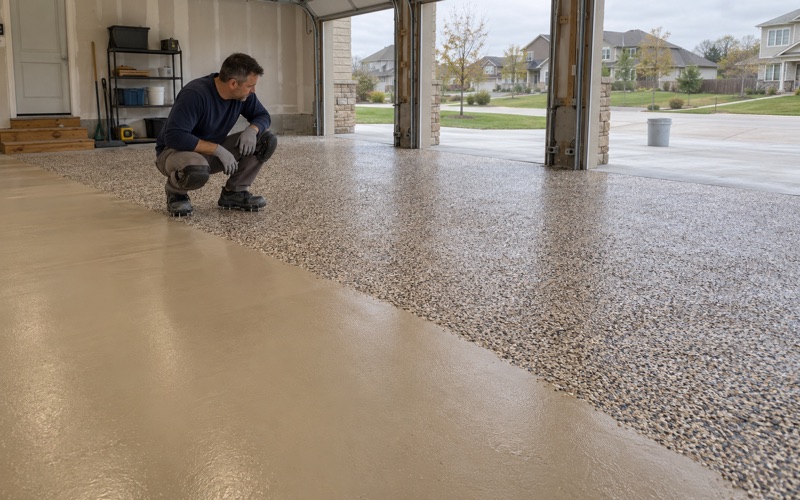
Iowa City Epoxy Flooring has spent more than 20 years on epoxy flooring in Tiffin and across Johnson County, and here the first question on many jobs is not which flake color to choose. It is who owns the concrete. A large share of Tiffin homes are attached townhomes and condominium units, and in that kind of building the garage or basement slab may not belong to the person who parks on it.
So a Tiffin estimate starts with paperwork as well as a grinder. We ask whether the unit sits inside a condominium regime, whether the association has a rule about floor work, and whether neighbors in the same building already have a coating worth matching. Those answers shape the scope as much as the condition of the slab does.
None of that replaces the floor work itself. Every slab we coat is opened mechanically, tested for moisture as part of the written scope, and quoted with the product line, coat count and finished thickness named. That way the owner and the board can both hold the finished floor up against the proposal.
Tiffin Is a Town of Townhomes and Condominiums
Attached units outnumber detached houses
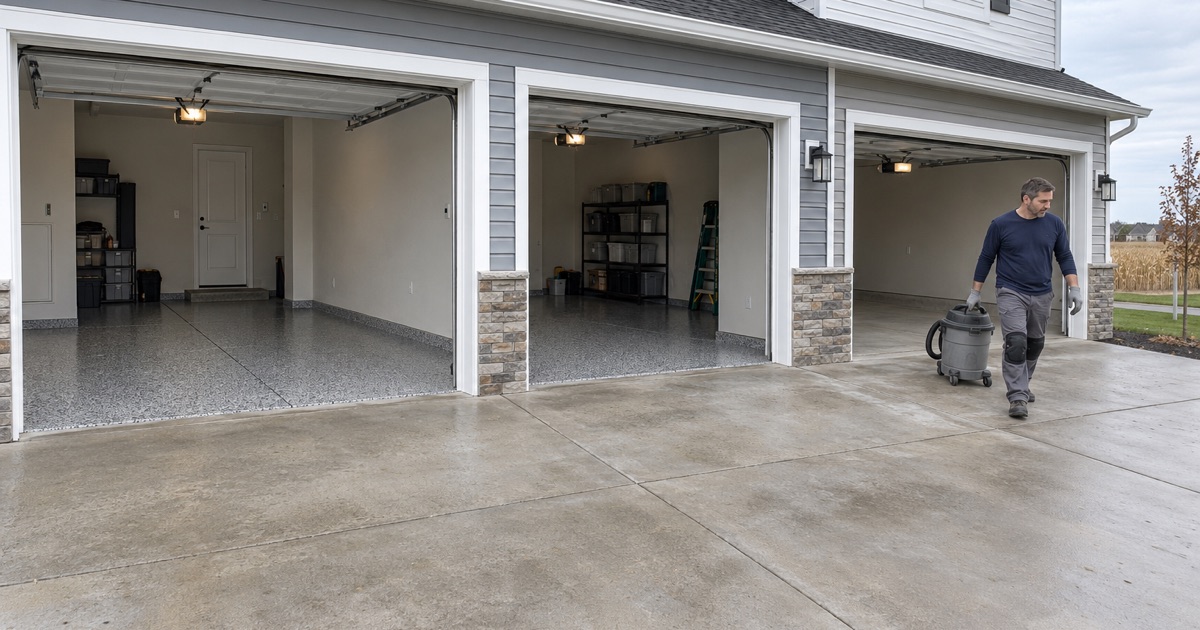
The American Community Survey for 2020-2024 counts 1,010 attached single-family units in Tiffin against 934 detached houses. Among owner-occupied homes, 44.5 percent are attached. For a city of this size that is an unusual mix, and it means a garage floor request here is often a request about a shared building rather than a standalone house.
Most of that housing is recent, but a newer building settles nothing about moisture or ownership. We test the slab whatever year it was poured, because a newer house is not automatically a drier garage. We also treat the ownership question separately, since a garage in a recent townhome can still sit on concrete the association controls.
Sixteen registered condominium associations
A third-party directory that draws on public registrations lists 26 HOA and condominium communities in Tiffin, 16 of them condominium associations. Names on that list include Valley Village I, III and VII, Freeman Condominiums Phases 1, II and III, Pheasant Brook, Hillside and Central Park. We have not read those declarations, and each one may treat floors differently.
That is why we never assume. An owner in one of those buildings may hold full control of the garage slab, or may need a board vote, a request form or a written approval first. The only reliable answer comes from the recorded declaration and the board that administers it, and we ask about both before we settle a final scope.
Questions we ask at the first visit
Before we price anything, we ask whether the unit is part of a condominium association or a homeowners association, and whether the owner has a copy of the declaration and bylaws. We ask if the board has already approved, denied or set standards for floor coatings in the building. We also ask whether neighboring garages carry a finish the board expects new work to follow.
If the owner does not know, that is normal, and it does not stop the visit. We still read the slab, map its cracks and old coatings, and take moisture readings. The owner then carries a written scope to the board instead of a verbal promise, which tends to make the approval conversation shorter and clearer.
Looking for epoxy-flooring closer to North Liberty? See North Liberty Epoxy-Flooring.
Who Owns the Slab: Iowa Code 499B and Your Declaration
What the Horizontal Property Act says about floors
Iowa condominiums are created under Iowa Code chapter 499B, the Horizontal Property Act. Section 499B.2(5) defines general common elements, and unless the declaration provides otherwise, that list includes the land, the foundations, basements, floors, exterior walls, ceilings and roofs. Read plainly, the default places condominium floors in shared ownership rather than with the individual unit owner.
The phrase that matters is unless otherwise provided in the declaration. A developer can draw the lines differently when the regime is recorded, and the declaration can later be lawfully amended. So the statute tells us where to look, not what the answer is for any specific Tiffin building.
Common elements, limited common elements and your garage floor
Section 499B.2(6) creates a second category, limited common elements, which the declaration reserves to one or more units to the exclusion of the others. Under 499B.4(5), the declaration must describe those elements and state which units they serve. An attached garage stall or a basement floor is the kind of space that may be assigned this way.
If your garage slab is a limited common element, you may have exclusive use of it while the association still holds a say over its condition, appearance or alteration. If it is a general common element, the board may treat a coating as a change to shared property. Either way, the declaration decides, not our proposal and not a neighbor’s experience.
The bylaws and who pays for slab repair
Section 499B.15(4) requires the bylaws to provide for maintenance, repair and replacement of the common areas and the payments for them. That can decide whether the owner or the association pays when a slab needs work, and it can leave the association responsible for a floor it later has to grind off or replace.
We map cracks, spalls and failing old coatings first, and we say so when a slab needs repair or replacement before it should be coated. In a condominium, that finding may belong in front of the board rather than the owner alone. The statute has no section on alterations by an individual owner, so the declaration and bylaws carry that question, and the board or its attorney reads them.
Getting Association Approval Before a Coating Goes Down
A written scope a board can review
A board reviewing floor work usually wants to know what goes down, how the surface is prepared and how long the space is out of use. Our proposal answers the first question directly. It names the product line, the number of coats and the finished thickness, so a reviewer can compare the completed floor to what was approved.
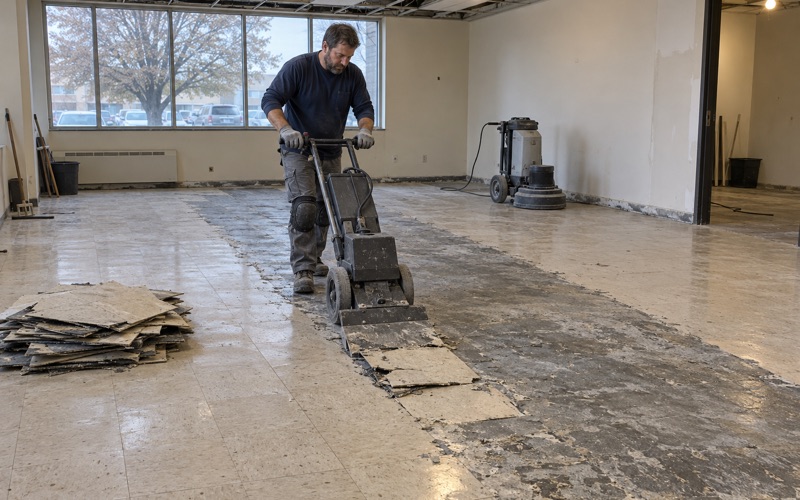
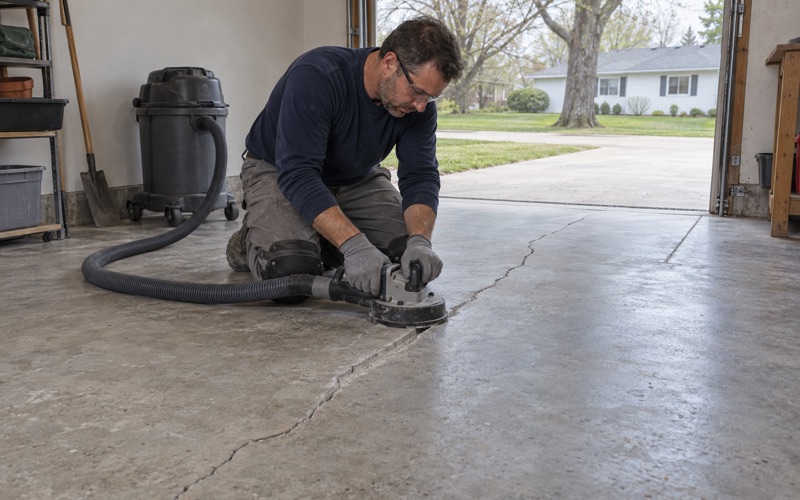
Preparation is written out too. Every slab is opened with a diamond grinder or a shot blaster to a measured ICRI concrete surface profile, never an acid etch. Grinding dust is captured at the machine by vacuum rather than rinsed toward a floor drain or a storm inlet, which matters in a building where drains and drives are shared.
Moisture testing goes into the scope
Tiffin’s soils change across town. The Clear Creek bottom carries poorly drained Colo, Lawson and Bremer soils with a seasonal water table at or near the surface, while upland subdivisions sit on Fayette and Tama-Dickinson silt loams. That variation is a reason to test rather than guess, and a test result is something a board can keep with its approval.
Depending on the slab, we use ASTM F2170 in-situ relative humidity probes, an ASTM F1869 calcium chloride test, or an ASTM D4263 plastic sheet check as a first read. The result goes into the scope before the price is final. When readings run high, we name a moisture-mitigation primer or advise against coating.
Permits and the City of Tiffin Building Department
The City of Tiffin Building Department enforces the 2018 International Building, Residential and Property Maintenance Codes, along with the Iowa State plumbing, mechanical and electrical codes. Permit applications go through the city’s online portal, and inspections need 24 hours notice. The city has not published a permit exemption list for floor finishes.
If a board or an owner asks whether coating work in a Tiffin garage needs a permit, the Building Department is the right place to ask, and we would rather that question be answered before work starts. A board approval and a city answer are separate things, and a shared building may need both on file.
Matching Finishes Across Shared Buildings
Why consistency matters in an attached row
In a row of attached units, a garage floor is visible every time a neighbor’s door goes up. A declaration that controls exterior appearance may reach into a garage that opens onto a shared drive, and some boards set a standard color or texture. Even where no rule applies, owners in one building often want floors that look like they belong together.
When a neighboring unit already has a coating, we document its base color, flake blend and texture so a second floor comes close. Exact matches between batches and installers are never guaranteed, and we say so before work begins. Slip resistance is set by the broadcast and topcoat we specify, and that choice is written down for the board.
Systems that stand up to winter salt
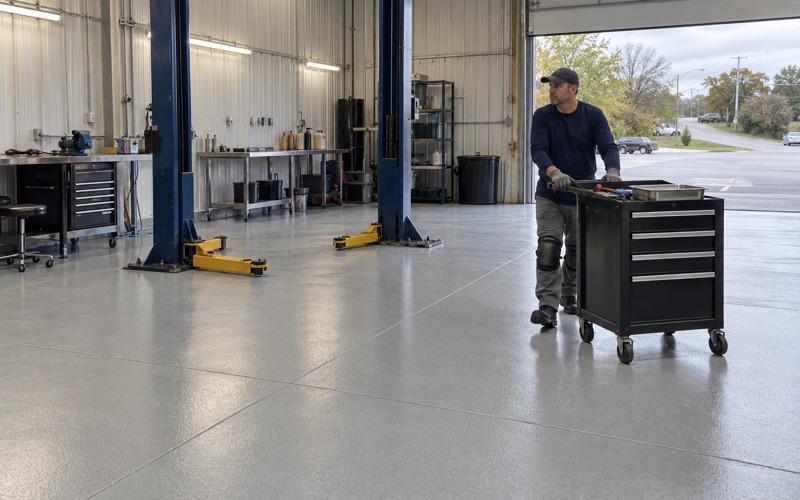
Tiffin sits at the junction of Interstates 80 and 380, and from November through March tires carry brine and rock salt into every garage in town. We choose garage systems for that exposure, typically a 100% solids epoxy base with a vinyl flake or quartz aggregate broadcast and a polyaspartic topcoat that resists hot tire pickup.
Cure schedules follow slab temperature and the dew point spread at the surface, not the calendar. An unheated garage in an eastern Iowa winter is told to wait. In a shared building, that schedule goes into the scope so the board and the neighbors know which stalls are out of use and for how long.
What a coating is not
A garage or basement coating does not stop water. Before quoting a basement floor in a condo or townhome, we look for signs of past water and check the sump pit and floor drain, because a coating will not hold back seepage or hydrostatic pressure. Moisture is the first exclusion we name when we explain what a warranty leaves out.
A coating is also not radon work. In Iowa, radon testing and mitigation require a state credential under Iowa Code chapter 136B, and every Iowa county is radon Zone 1. We offer low-odor products for attached garages and basements as a comfort and re-entry choice, never as something Iowa law requires.
- 20+ Years Coating Concrete
- Moisture Test in Every Scope
- Free Written Estimates