
Iowa City Epoxy Flooring grinds and polishes concrete floors in Iowa City, IA, serving surrounding cities including Coralville, Tiffin, North Liberty, Mount Vernon and Amana. Polished concrete turns the slab you already have into the finished floor, with no coating on top to peel, and it suits everything from a warehouse aisle to a finished basement.
The process is grinding, not coating. We cut the surface down with progressively finer diamond tooling, harden it with a lithium silicate densifier, and refine it to the sheen you want. The result depends heavily on the concrete underneath, which is why every polished floor we quote starts with a small test grind on your own slab.
Our more than twenty years in concrete floors also tell us when polishing is the wrong answer. A slab with heavy patching, deep stains or a chemical-spill workload may be better served by a coating, and we will tell you that before you commit.
How Polished Concrete Is Made
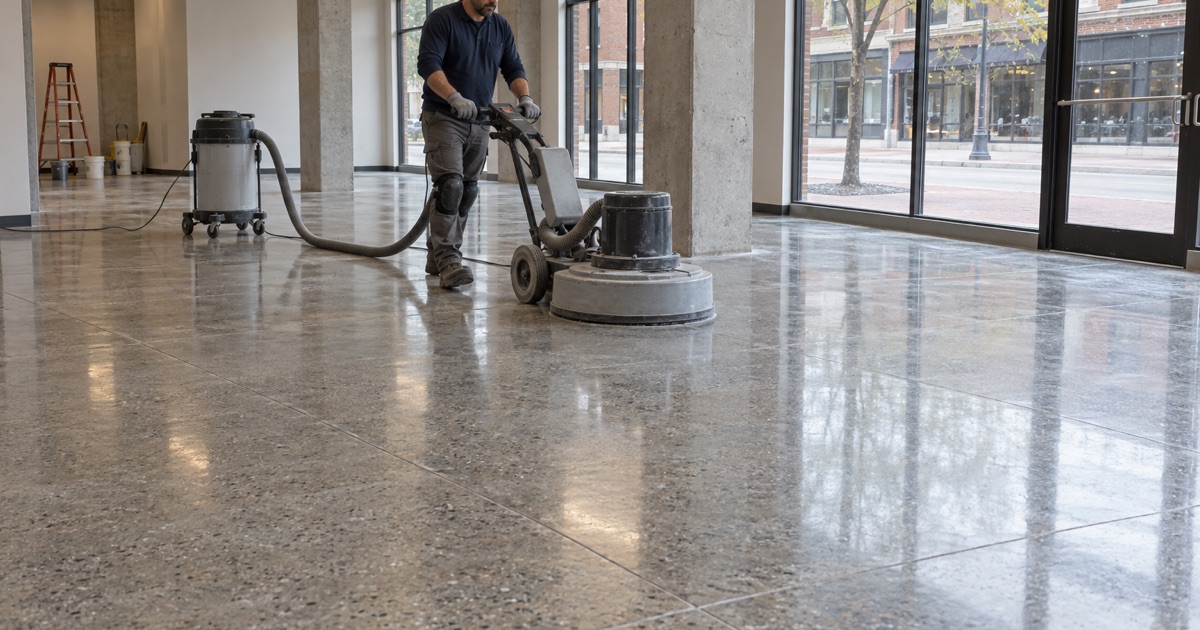
Grinding Passes and Diamond Tooling
The first passes use coarse metal-bond diamonds to remove surface paste, old sealers and minor imperfections. Each later pass uses a finer grit, removing the scratches left by the one before, until the surface is smooth enough for resin-bond polishing pads to take over.
Skipping a step shows in the finished floor as swirl marks and dull patches under raking light. We keep the sequence complete and check the floor between passes, because the scratch pattern from an early grit is far easier to remove before the floor is densified.
Densifier and Surface Hardness
Partway through the grit sequence, a lithium silicate densifier is applied to the open surface. It reacts with the concrete to harden the top layer, which reduces dusting and improves how well the floor takes and holds a polish.
A densified floor is also easier to keep clean, since the surface absorbs less. That matters in a shop or a basement where spills happen and the floor has no coating to keep them on the surface.
Guard, Sealer and Final Sheen
After the final polishing pass, a penetrating guard or sealer is applied and burnished in. It adds stain resistance and evens out the sheen across the room, and it is the part of the system that gets refreshed during maintenance.
The final sheen can range from a soft satin to a high reflective gloss, depending on how far the grit sequence goes. Higher gloss shows more depth but also more scuffs, and we help you pick a level that suits how the floor is used.
Aggregate Exposure and Finish Choices
Cream Finish
A cream finish keeps the grind shallow, polishing the top paste layer without exposing the stone below. It gives a smooth, uniform look and suits newer slabs with a consistent surface.
Because the cut is shallow, a cream finish also shows any trowel marks, patches and stains that sit in that top layer. The test grind tells us whether your slab can carry a cream look or whether a deeper grind will produce a more even floor.
Salt and Pepper Finish
A medium grind exposes fine aggregate, the sand and small stone just below the surface, giving a speckled look often called salt and pepper. It is a popular choice for retail spaces, offices and modern basements.
This level of exposure hides minor surface variation better than a cream finish. It also tends to read as intentional, which suits older slabs whose top layer is less even.
Exposed Aggregate Finish
A deep grind cuts down to the larger stone in the mix, producing a terrazzo-like look. It takes more grinding time and works best on slabs where the aggregate is evenly distributed, which we confirm with the test area before quoting.
On some older slabs the aggregate sits unevenly, so a deep grind shows heavy stone in one area and paste in another. We would rather show you that on a small test patch than discover it across the whole floor.
Polished Concrete for Businesses and Homes
Commercial and Industrial Polished Floors
Warehouses, retail stores, offices and showrooms choose polished concrete because it has no coating to chip under forklift wheels, pallet jacks or carts. It reflects light well, which can brighten large spaces, and maintenance is mostly dust mopping and periodic burnishing.
We phase commercial work around operating hours, polishing in zones so part of the building stays open. Joints are filled with a semi-rigid filler where wheeled traffic crosses them, which protects the joint edges from chipping.
Residential Basements and Living Spaces
In a home, polished concrete suits finished basements, mudrooms and modern living areas built on slab. With no film on top for moisture to lift, it can be a good fit for a basement where a coating would be a risk, though the slab still needs a check for past water first.
For older Iowa City basements, the first job is often removing old tile glue, paint and patches. That work changes how even the final look will be, so we discuss it during the test grind rather than after.
Area Rugs, Furniture and Daily Wear
A polished floor resists scratching well, but grit tracked in from outside acts like sandpaper over time. Walk-off mats at the doors and felt pads under furniture keep the sheen even in the rooms people use most.
Rugs on a polished floor should have breathable backings, since a rubber backing can leave marks on the guard. Those small habits keep the floor looking finished between maintenance visits.
What Shapes a Polished Concrete Quote
Slab Condition and Prep Work
The biggest variable in a polished floor is what is already on the slab. Carpet glue, tile mastic, paint and old sealers all have to come off before the first real grinding pass, and thick adhesive can take longer to remove than the polishing itself.
Cracks, control joints and spalled areas also add time. Some owners want cracks filled to match; others prefer to leave them as part of the floor’s character, and we price each approach so you can choose.
Finish Level and Aggregate Depth
A cream finish at a satin sheen takes fewer passes than an exposed aggregate floor polished to high gloss. Every extra step in the grit sequence and every extra millimeter of cut adds machine time, so the look you choose sets much of the price.
The test grind is where this becomes concrete. Once you can see what your slab looks like at each depth, picking a finish becomes a decision about a visible result rather than a guess from a brochure photo.
Access, Occupancy and Scheduling
An empty new building is the simplest polishing job. An occupied store, an office that cannot close or a basement full of furniture takes more planning, more moving and more phasing, and that time is part of the quote.
For businesses that cannot shut down, we can work nights and weekends in sections. For homes, we plan the dust control and the order of rooms so the household can keep using the rest of the house.
Keeping a Polished Floor Looking New
Routine Care
Daily or weekly dust mopping removes the grit that dulls a polished floor fastest. Damp mopping with a pH-neutral cleaner handles spills and scuffs, and an auto-scrubber with soft pads is the commercial version of the same routine.
Periodic Burnishing and Re-Guarding
Over time the guard wears in high-traffic lanes, and the sheen there drops compared with the edges of the room. A high-speed burnish often brings it back; heavier wear calls for a fresh coat of guard, and only rarely does a floor need to be reground.
- 20+ Years Coating Concrete
- Moisture Test in Every Scope
- Free Written Estimates