Iowa City Epoxy Flooring has done epoxy flooring in North Liberty and across Johnson County for more than 20 years, and the work here keeps coming back to one question: what is the slab underneath doing? A coated lobby, a concession floor or a restroom is only as sound as the concrete it bonds to, so we read that concrete before we price anything.
Our proposals put the moisture test inside the written scope rather than after the deposit. The same document names the product line, the number of coats and the finished thickness, so a facility manager or owner can hold the finished floor up against the quote and check it line by line instead of taking our word for it.
This page is about a kind of building the city keeps adding: the multi-use sports facility, where several floor systems share one slab and one set of moisture readings. If you manage, plan or own space like that, the sections below explain how the readings are taken, where a coating belongs and where it does not.
Sports Buildings in North Liberty Put Several Floors on One Slab
The Palestra and the Corridor Sports Performance Center
North Liberty is a suburb of Iowa City that grew from 5,367 residents in 2000 to 20,479 in 2020, and youth sports have grown with it. The Palestra, at 1455 Hayes Lane, runs four full-size hardwood courts for basketball, volleyball and pickleball, along with a turf training field, batting cages upstairs and office space.
The Corridor Sports Performance Center is the newer project. The Gazette reported in September 2025 that the facility, near Liberty High School at Dubuque Street and North Liberty Road, would cover nearly 45,000 square feet with four courts, physical therapy and fitness space leased to outside partners, and community event space, at an estimated 10 million dollars.
We have no connection to either building, and neither one’s floor specification is something we have read; the Gazette article does not mention flooring at all. We use them because they show, at full scale, the problem a smaller gym, training studio or activity hall in town runs into when several floor types share a single pour.
Maple, coatings and resilient floors side by side
In a building like this, the courts are maple, laid by sport-floor contractors working to the Maple Flooring Manufacturers Association’s guidance. The lobby, concession stand, restrooms and storage rooms usually take a resinous coating, and the therapy and fitness rooms often take a resilient floor such as rubber or sheet vinyl glued to the concrete.
Each of those systems has its own moisture tolerance, but they all sit on concrete drying under the same roof. That is why one disciplined set of readings, taken across the whole slab, does more good than three trades each guessing about their own rooms and comparing notes only after something goes wrong.
Why the ground matters here
The USDA soil survey around central North Liberty maps Colo-Ely and Maxfield soils, both poorly drained, with a seasonal water table at or near the surface, and the somewhat poorly drained Klinger silty clay loam beside them. Ground like that keeps feeding moisture toward the underside of a slab long after the building is closed in.
None of that means a floor will fail. It means slab moisture gets measured before any floor system goes down, and it is the reason we never describe a coating as waterproofing or radon work. A coating is a wear surface, and it depends on the concrete staying within the limits its maker sets.
Looking for epoxy-flooring closer to Mount Vernon? See Epoxy-Flooring in Mount Vernon.
How the Slab Is Read: In-Situ Relative Humidity to ASTM F2170
What the maple industry accepts
The MFMA is blunt about method. Its guidance on concrete slab moisture calls relative humidity testing ‘the only MFMA recognized method’ for reading moisture inside a slab, and it asks that the test kit comply with the most recent ASTM F2170. It treats calcium chloride and plastic-film tests as pre-tests only, useful for screening and nothing more.
The thresholds are 85 percent relative humidity or lower for a non-glue-down maple system and 75 percent or lower for a glue-down system. Those are the association’s recommendations for maple floors, not a building code requirement, and the MFMA places the responsibility for delivering a dry slab on the general contractor.
How an F2170 test works
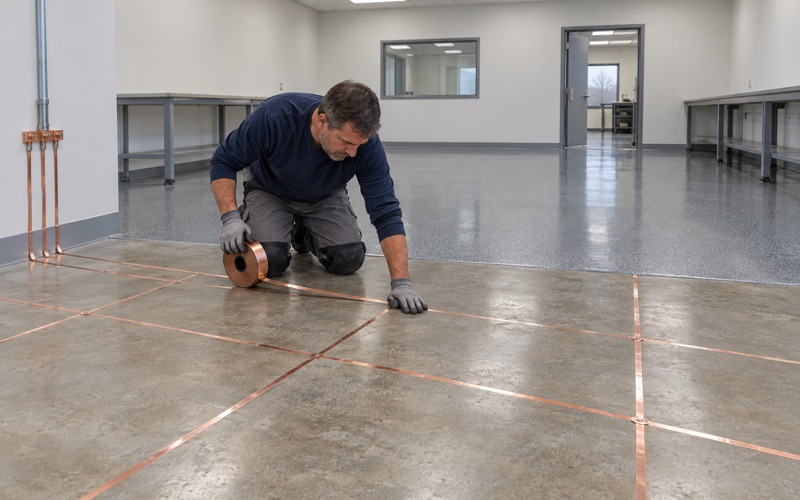
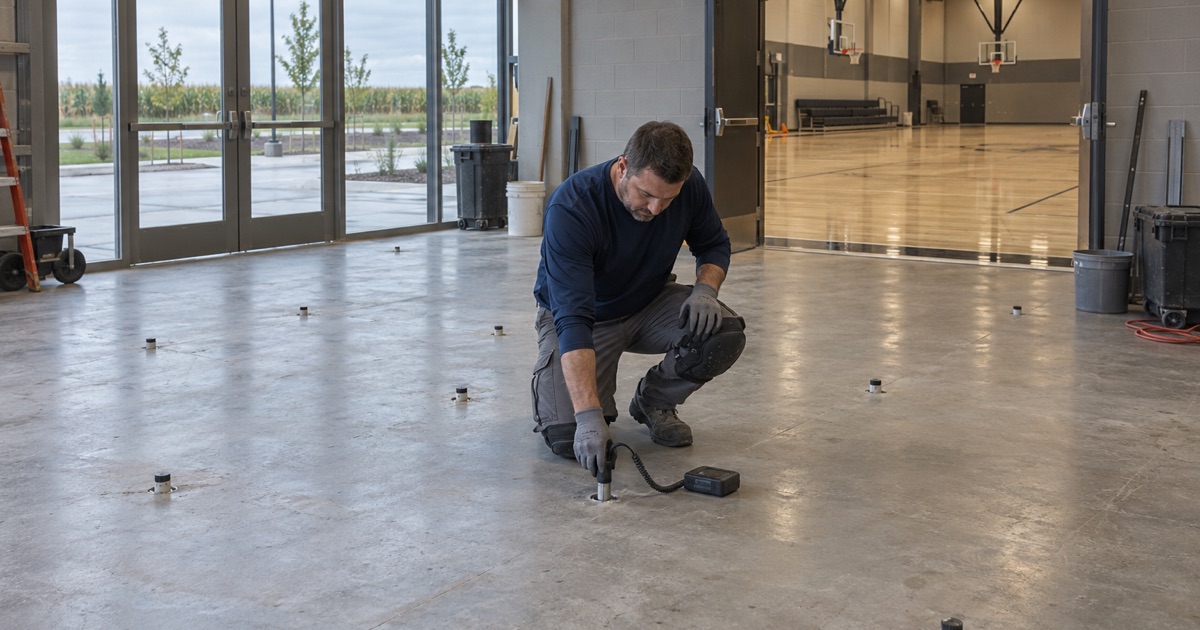
ASTM F2170 measures relative humidity inside the concrete rather than at its surface. Holes are drilled to a set depth, sleeves go in and are sealed, and the probes equilibrate before a reading is recorded. Because the probe sits in the slab’s interior, it reports what the floor covering will eventually feel once the surface is sealed over.
Surface tests answer a narrower question. The ASTM F1869 calcium chloride test captures what evaporates from the top in a set window, and the ASTM D4263 plastic sheet test shows only whether moisture condenses under a taped square. Both have their uses, but neither tells you what is waiting a couple of inches down.
Timing matters too. A reading is most meaningful when the building is enclosed and the heating and air conditioning run at the conditions the occupants will use, because a slab tested in an open shell reads differently once the roof and mechanical systems change the air above it.
Reading the whole building, not one room
On a multi-system slab, the useful approach is to place probes in every zone that will receive a floor, including the lobby, concessions, restrooms and therapy rooms as well as the courts. A slab can read dry under a sunny entry and wet in an interior storage room over poorly drained ground.
We write the F2170 readings into our proposal and keep them alongside the product data. When the coating manufacturer, the resilient flooring manufacturer and the maple installer all work from the same numbers, nobody has to argue later about whose floor the moisture was supposed to be, or which room was tested and which was assumed.
Where Coatings Belong: Lobbies, Concessions, Restrooms and Storage
Lobbies and corridors
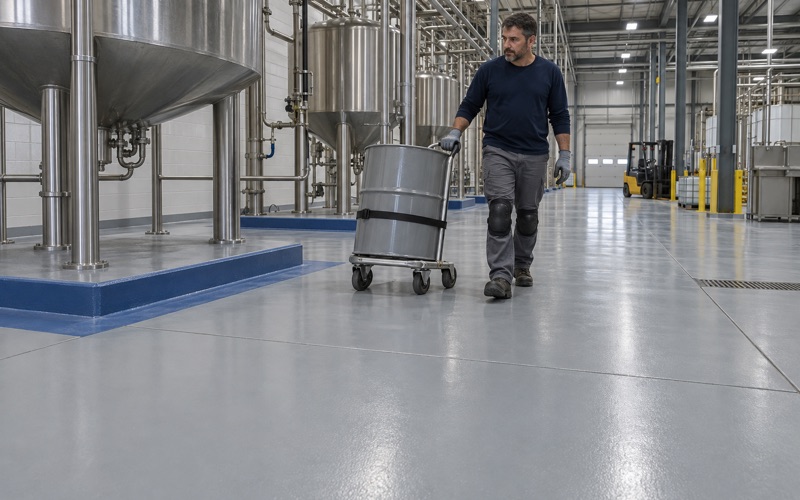
A sports lobby takes wet shoes, tracked grit, folding tables and a steady stream of families, most of it on winter weekends. A broadcast system with vinyl flake or quartz aggregate, sealed under a polyaspartic or urethane topcoat, holds up to that traffic, and the texture comes from the broadcast and topcoat we specify rather than from a promise on a brochure.
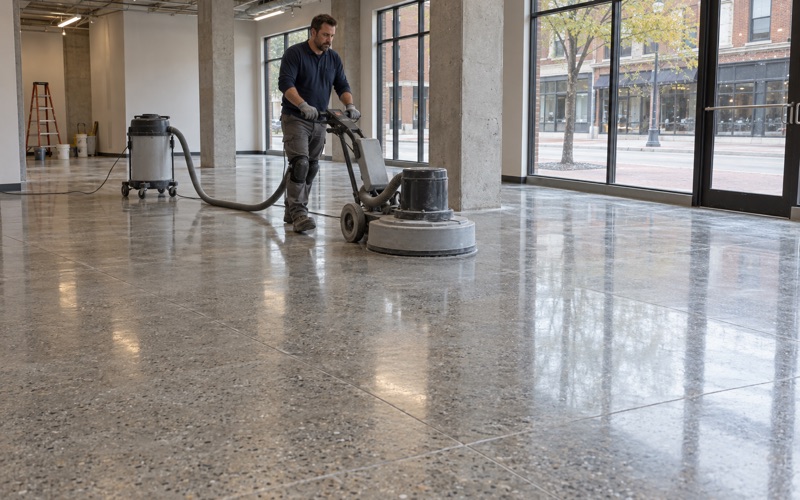
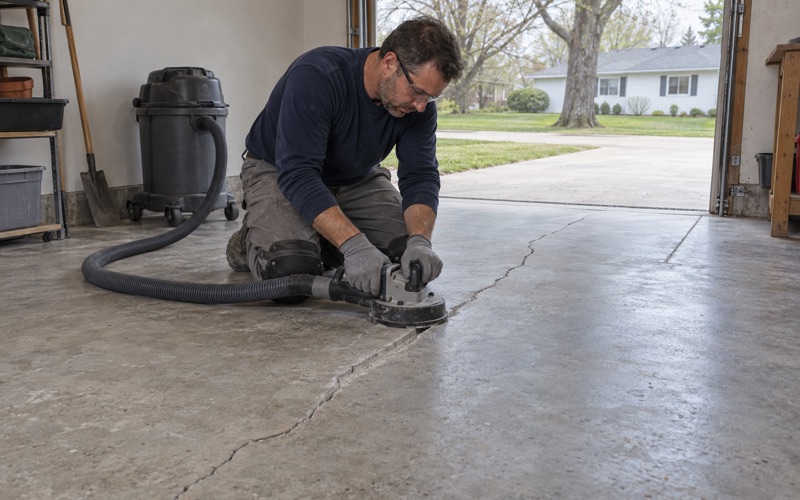
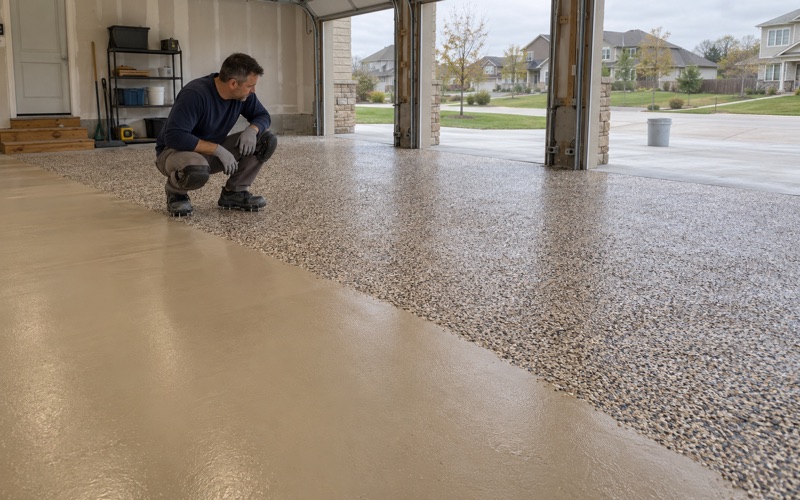
Every slab we coat is opened with a diamond grinder or a shot blaster to a measured ICRI concrete surface profile, never an acid etch. Grinding dust is pulled into a vacuum at the machine, which matters in a building that is often open and in use while one wing is being finished.
We schedule cure windows by slab temperature and the dew point spread at the surface, not by a calendar date. In a facility that hosts tournaments, that usually means working overnight or between weekend events in phases, so courts and entrances stay open while a coated zone cures behind a barrier.
Concession stands and food areas
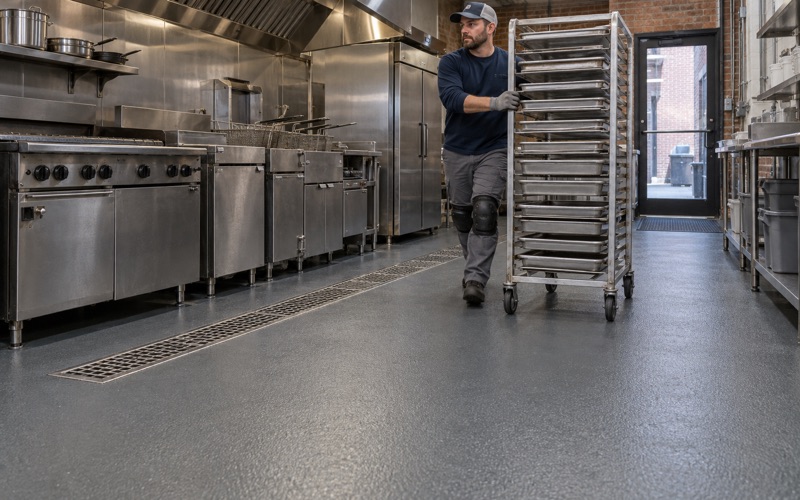
A concession counter that prepares or serves food falls under Johnson County Public Health, which licenses and inspects food establishments against the 2017 FDA Food Code with Supplement as Iowa adopts it. We plan those floors with coved bases where the floor meets the wall and a texture chosen for spills, in line with the code’s floor provisions.
A urethane cement system is often the better pick behind a counter that sees hot water, grease and daily mop-downs. We talk through the cleaning routine and the equipment layout before choosing between that and a 100% solids epoxy, because the floor has to survive how the staff actually work, not how the drawing looks.
Restrooms and storage rooms
Restrooms in a busy facility want a seamless floor with a coved base, so water and cleaning chemicals have nowhere to sit. Storage and equipment rooms are the opposite case: little foot traffic, but carts, ball racks and stacked bleachers that scuff and gouge an unprotected surface over a season.
Both are often interior rooms far from the exterior walls, which is exactly where a relative humidity reading can surprise people. We map cracks, spalls and any old coating in these rooms first, and we say so plainly when a section needs repair before it should be coated at all.
Moisture Mitigation Under Fitness and Therapy Floors
When a reading comes back high
If the F2170 readings in a therapy or fitness room come back above what the resilient flooring maker allows, there are three honest options: wait for the slab to dry, change the flooring, or install a moisture-mitigation system first. Which one fits depends on the schedule, the readings and what each manufacturer will put in writing.
We are not the flooring contractor for rubber or sheet goods in those rooms. Our part is the layer underneath when one is needed, applied to a properly profiled slab so the resilient installer gets a sound, compatible surface to glue to and a written record of what went down.
What ASTM F3010 covers
ASTM F3010-24, the current standard practice for two-component resin membrane-forming moisture mitigation systems under resilient floor coverings, covers how those membranes are evaluated, applied and expected to perform on high-moisture slabs. It includes surface preparation recommendations, and it does not override the written instructions of the membrane, flooring, underlayment or adhesive manufacturers.
In practice, that puts the manufacturers’ published limits in charge. We match the membrane to the adhesive the resilient installer intends to use, and we confirm the combination before work starts rather than after the first seam lifts. Grinding to the profile the membrane maker calls for is part of that same check.
Limits, warranties and sign-off
A moisture-mitigation membrane controls vapor coming up through the slab so a floor covering can bond and stay bonded. It is not waterproofing, it does not stop water entering through a crack or joint, and it is not radon mitigation, which in Iowa requires a state credential under Iowa Code chapter 136B.
Our warranty conversation starts with moisture, because moisture vapor transmission and hydrostatic pressure are the first exclusions most coating warranties name. We explain those limits before a job is sold, so a facility owner knows what the membrane and the coating above it are designed to handle and what still depends on the site.
North Liberty’s Building Inspection Department, within Planning, Building, & Development at City Hall on North Main Street, enforces the 2021 International Building Code and related codes. The city does not publish permit exemptions for finish work, so we ask that office before assuming a coating-only scope inside a commercial building needs no permit.
- 20+ Years Coating Concrete
- Moisture Test in Every Scope
- Free Written Estimates