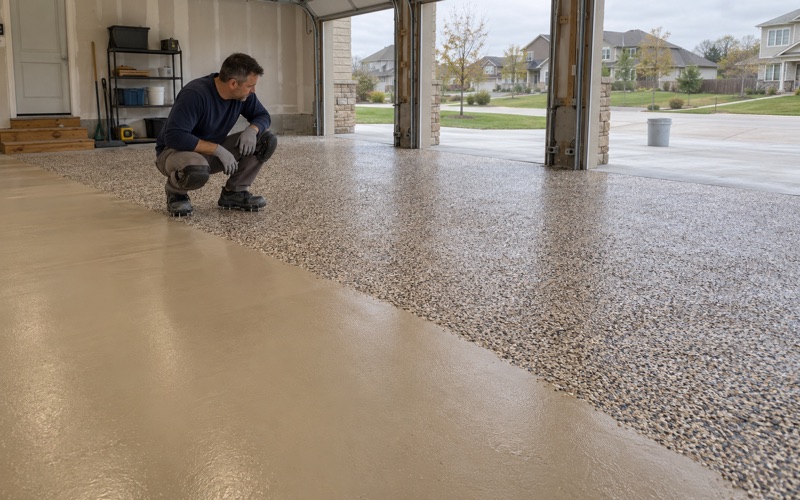
Iowa City Epoxy Flooring has spent more than 20 years on epoxy-flooring in Mount Vernon and the rest of eastern Iowa, and the part of the job owners ask about first here is rarely the color chart. It is the calendar. When a building stays in use, the coating has to be ground, laid, cured and aired out inside a window the occupants can actually give up.
That makes timing the first line of our scope rather than an afterthought. We map cracks, spalls and old coatings, run a moisture test, and then work backward from the dates a room can sit empty. The proposal names the product line, the coat count and the finished thickness, so whoever signs off can check the floor against the paper.
The second question in town is about rules: which office reviews the work, and whether a historic district changes anything for an inside floor. We cover both below, along with the limits of what the published pages actually say.
One Course at a Time and the Gap Between Blocks
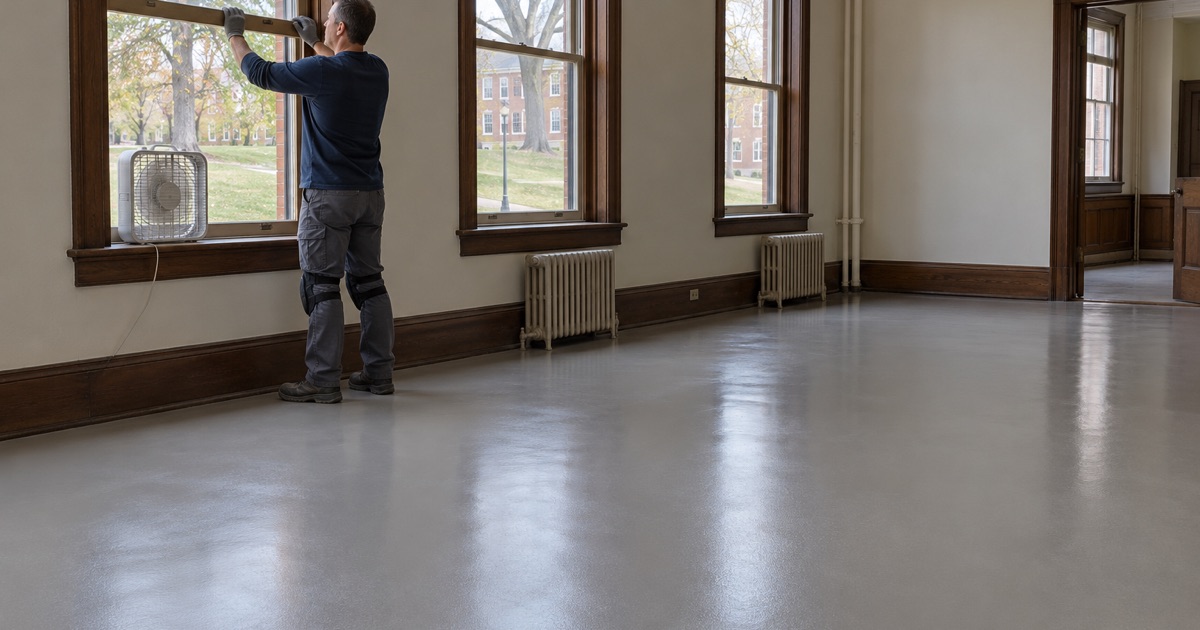
Mount Vernon is home to Cornell College, the private liberal arts school founded in 1853 and the first college in Iowa to admit women. Cornell teaches One Course at a Time: students take a single class for a block of about three and a half weeks, then move to the next. That rhythm sets the pace for buildings on and around campus.
How the 2026-27 calendar lays out
The 2026-27 calendar runs eight blocks. Block 1 is August 24 to September 16, Block 2 is September 21 to October 14, Block 3 is October 19 to November 11, and Block 4 is November 16 to December 16. Block 5 opens January 11, Block 6 runs February 8 to March 3, and Block 8 closes May 5.
Between most blocks the calendar leaves a short Thursday-to-Sunday gap. Block 1 ending on a Wednesday and Block 2 starting on a Monday is the pattern. Those dates belong to one academic year only; the block dates shift annually, so we confirm the current calendar with the building owner before we commit a crew to any window.
Why four days is a real window, and a tight one
Four days can hold a grind, a primer, a broadcast and a topcoat on a modest room, but there is no slack in that plan. If the slab tests wet, the moisture-mitigation primer adds a step and its own recoat interval. If a crack map turns up more repair than expected, the coating moves to a longer break instead.
We would rather say that during the walkthrough than discover it on Thursday morning. A house, a rental or a shop near campus that follows the same rhythm gets the same honest read: what fits in the gap, what needs a longer one, and what the slab needs before either.
Day traffic versus the gap itself
The calendar also notes that classes end by 3 p.m., except on the eighth and eighteenth days of a block, which end by noon. Those afternoons can carry prep that makes little noise or dust, such as crack mapping and moisture testing. The grinding, coating and cure stay inside the gap itself.
Looking for epoxy-flooring closer to Amana? See Epoxy-Flooring Services in Amana.
Fitting Prep, Cure and Odor Into a Block Break
A block break is short enough that every hour has a job. We plan the sequence on paper first, then set the start time by slab temperature and the dew point spread at the surface, not by the date on the calendar. A cold floor near its dew point can collect condensation that fogs a coat or leaves amine blush.
Opening the slab on day one
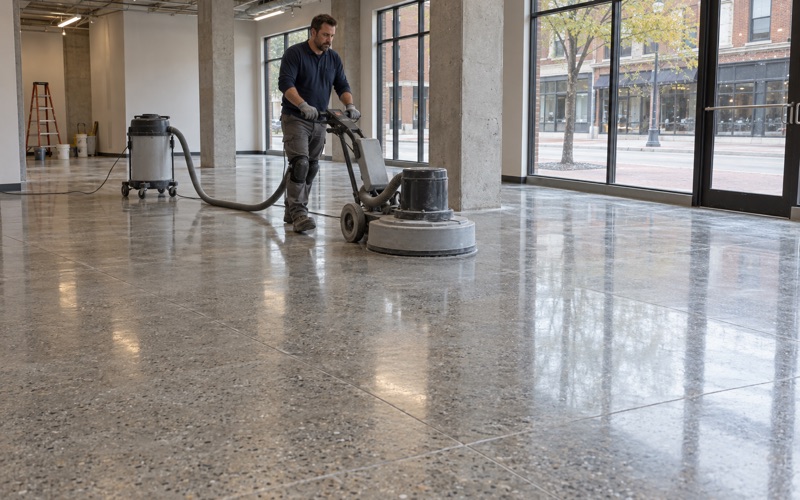
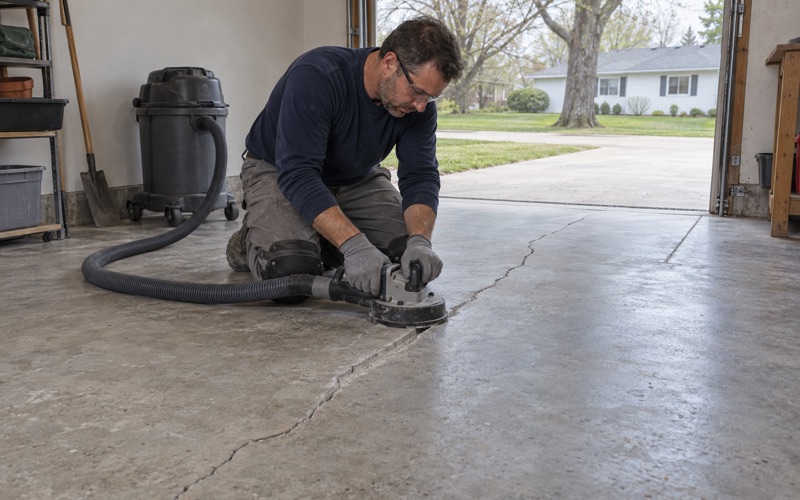
We open the concrete with a diamond grinder or a shot blaster to an ICRI concrete surface profile the system calls for, never an acid etch. Dust is pulled into a vacuum at the machine rather than rinsed toward a floor drain or out to a storm inlet, which also keeps the room usable sooner.
Older slabs in this town often carry patches, paint and sealers from earlier owners. A densifier or a penetrating sealer can block a coating from bonding, so we test what is on the surface before choosing a primer. That test belongs in the walkthrough, not in the middle of a four-day window.
Choosing chemistry for the clock
A 100% solids epoxy base gives build and strength, but it needs time between coats. Polyaspartic and polyurea topcoats cure faster and can shorten a schedule, which matters when the room reopens on Monday. We match the system to the window rather than squeezing a slow system into a gap it does not fit.
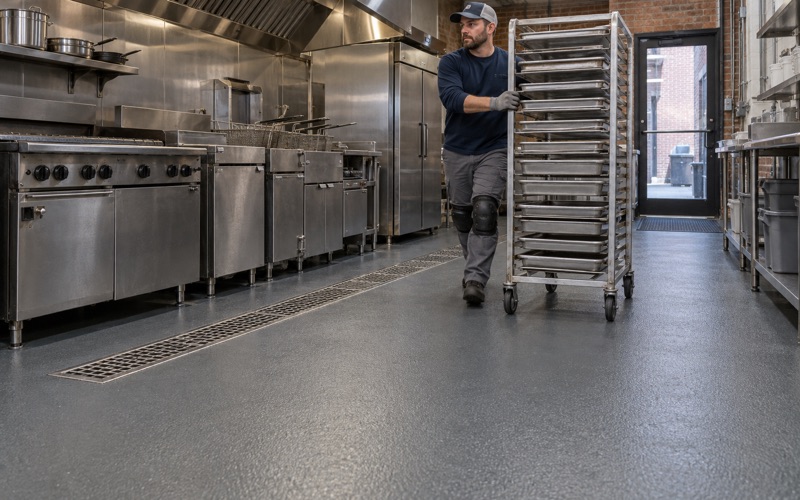
For a kitchen or wet area that serves the public, the plan follows the FDA Food Code as Iowa adopts it, including coved bases at the wall and a texture specified by the broadcast and topcoat. Linn County Public Health inspects food establishments here under contract with the state, so the finish has to suit their review.
Odor and re-entry
Fresh coatings carry odor, and in a building that people walk back into after a short break, that matters as much as hardness. We offer low-odor products as a comfort and re-entry choice for basements, attached garages and occupied spaces. Iowa has no state content rule requiring them; the federal architectural coatings rule binds the manufacturer.
We also leave margin at the end of the window for ventilation. A floor that is walkable but still smells strong on the first morning back is a scheduling miss, and we build the plan so the last coat goes down early enough to air out before anyone returns.
Longer Windows: Winter, Spring and Fall Breaks
Not every floor belongs in a four-day gap. A larger room, a slab that needs repair, or a system with a moisture primer and multiple broadcast coats wants a longer break, and the 2026-27 calendar offers three.
Winter break
Winter Break on the 2026-27 calendar runs December 17 to January 10, between Block 4 and Block 5. That is the longest stretch of the year and the one that can hold slab repair, a full grind, a moisture test that gets its full read, and a multi-coat system with proper recoat intervals.
The tradeoff is temperature. An unheated space in the middle of an Iowa winter can be too cold for a coating to cure as the manufacturer intends, and in that case we say to wait or to heat the room first. A long window does not help if the slab sits below the product’s curing range.
Spring break
Spring Break runs March 4 to 14, between Block 6 and Block 7. Eleven days is enough for most single-room systems with time left for odor to clear. It is often the better choice for an interior floor that needs a moisture-mitigation primer, because the extra coat no longer crowds the schedule.
Fall break
Fall Break falls November 23 to 27, inside Block 4 rather than between blocks. It adds five weekdays of lighter campus use, which can give a small project the day or two a block gap lacks. We treat it as one more option on the list and pick the window by the slab’s needs, not the other way around.
Historic Districts, Permits and Who Reviews What
Mount Vernon has three local historic districts: Ash Park, Commercial and Cornell College. The Cornell campus is described as one of only two college campuses in the country listed on the National Register of Historic Places. The Mount Vernon Historic Preservation Commission administers the preservation ordinance the city adopted in 1985.
The Certificate of Appropriateness covers the outside
In those districts, exterior changes, new construction, relocation and demolition need a Certificate of Appropriateness, or a certificate of No Material Effect, from the commission before a building permit. The commission’s own guidance says the ordinance does not require approval of interior changes, and that only changes to the exterior of a structure or site are subject to design review.
For an interior garage or basement coating, that means design review is not the step the commission describes. Exterior flatwork in a district is a different matter. A coated patio, a resurfaced walk or a new driveway sits outside, so we tell owners to talk with the commission before that work, not after.
The city for flatwork, Linn County for remodels
The city’s Building Permit Forms page splits the work. Concrete sidewalks, driveways and patios take a City of Mount Vernon permit. New construction and expansion, remodel or replacement of existing structures go to Linn County, along with electrical, mechanical and plumbing.
Neither page addresses a coating on an existing floor. We do not assume the answer either way; we ask City Hall at 213 First Street NW before the work is scheduled, and if a permit applies, the time it takes goes into the plan alongside the block calendar.
What a coating is not
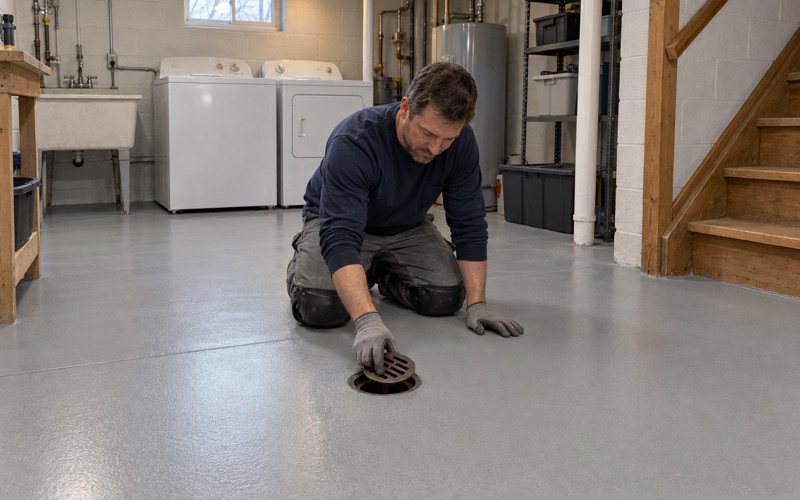
A floor coating is never radon mitigation, waterproofing or flood protection. In Iowa, radon testing and mitigation take a state credential, so we do not sell a coating as radon work. In a basement we check the sump pit and floor drain and read the slab for past water first, because a coating will not stop seepage, and moisture is the first warranty exclusion we explain before anything is sold.
- 20+ Years Coating Concrete
- Moisture Test in Every Scope
- Free Written Estimates