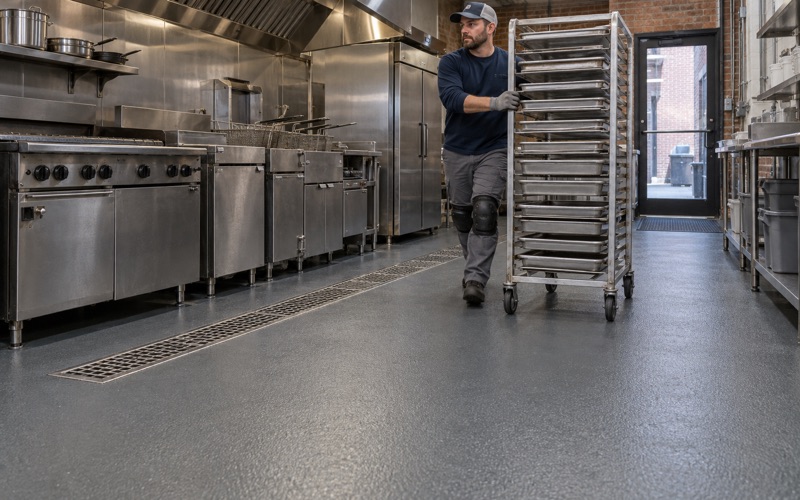
Iowa City Epoxy Flooring brings more than 20 years of epoxy-flooring work to Marion, and the jobs we plan most carefully here are the ones where the building cannot close for us. A floor in a space that stays occupied around the clock asks for a different schedule, a different sequence and a different set of questions before a grinder ever starts. We plan for that from the first walkthrough.
Every slab we coat is opened mechanically, by diamond grinding or shot blasting rather than an acid etch, so the coating bonds to a real surface profile. A moisture test sits in the written scope before the price is settled. The proposal names the product line, the coat count and the finished thickness, so the result can be checked against the paper it was sold on.
That discipline matters most in healthcare spaces, where an owner’s design team and the reviewing authorities both have a say over the work. Below is how we approach coating projects in facilities that stay open, what the state’s hospital construction rule says about renovations, and where the city’s own review fits in.
Two Emergency Departments With No Closing Hour
Both opened in 2024
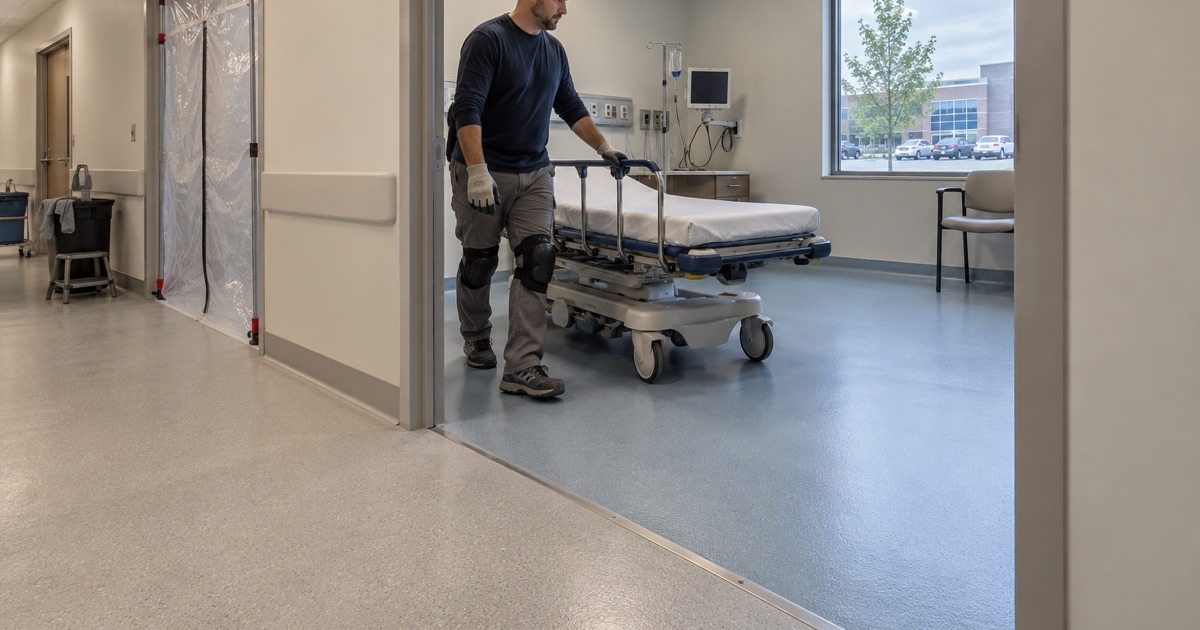
Marion added two freestanding emergency departments in 2024. UnityPoint - St. Luke’s Marion ER opened on August 6, 2024 at 3301 Armar Drive, near First Avenue and Highway 100, with 12 private treatment rooms, imaging and an on-site laboratory. Mercy’s Marion emergency department off Katz Drive followed with a ribbon-cutting that November.
Both are described by their operators as open 24 hours a day, seven days a week, 365 days per year. We have not worked on either building. We name them because they show plainly what a facility with no closing hour means for anyone planning floor work in a medical space in Marion.
No closure window to cure in
Most commercial coating schedules lean on a closure: a long weekend, a holiday shutdown or a slow week when a room can sit empty while the coats cure. A department that never closes offers none of that. The floor has to be resurfaced in pieces while the rest of the building keeps working around it.
That changes product choice as much as sequence. A system with a shorter return-to-service time, such as a polyaspartic topcoat over a 100% solids epoxy base, can shorten how long a zone stays out of use. Even so, the cure schedule is set by slab temperature and the dew point spread at the surface, not by the hour the zone is wanted back.
Phasing the work room by room
We map a phased job as a sequence of zones, each one closed, prepared, coated, cured and handed back before the next one opens. The owner decides which rooms can come out of service and when. Our job is to say honestly how long each zone needs and to keep the work inside the boundary that was agreed.
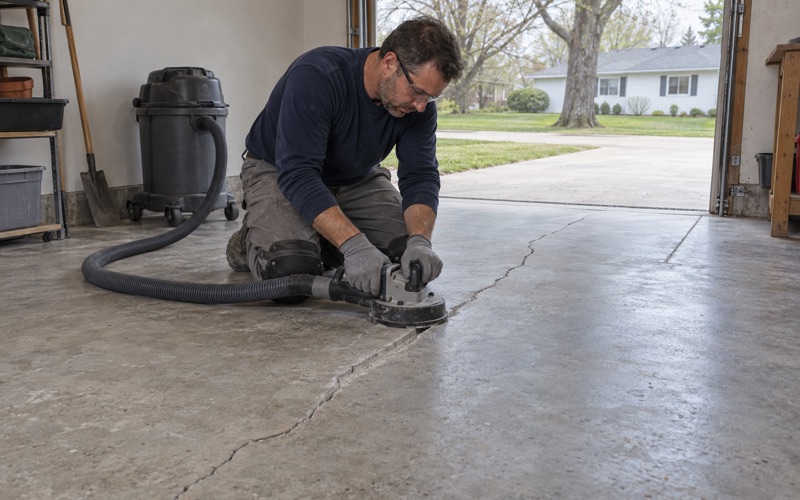
Dust and odor belong in that plan too. Grinding dust is captured at the machine by a vacuum instead of being swept or rinsed toward a drain, and low-odor products are available where a neighboring room stays occupied. Those choices are about comfort and keeping adjacent rooms usable, and we present them that way rather than as a health claim.
Looking for epoxy-flooring closer to Hiawatha? See Hiawatha Epoxy-Flooring.
The Construction Standard Iowa Sets for Hospital Premises
481 IAC 51.26 and the 2018 FGI Guidelines
Iowa’s Department of Inspections, Appeals, and Licensing sets construction standards for hospitals and off-site premises that fall under Iowa Code chapter 135B. Rule 481 IAC 51.26 points to the Guidelines for Design and Construction of Hospitals, 2018 edition, published by the Facility Guidelines Institute. Those FGI Guidelines are the design standard such a project is measured against.
We are careful about what we say next. We have not read the FGI text itself, so we quote no section from it and claim no floor requirement drawn from it. What a finish has to do in a given room is a decision for the owner’s design team working from that document, and our proposal is written to fit what they specify.
When a renovation has to meet the current edition
The rule deems a facility built to an earlier edition of the guidelines to be in compliance, with an exception. New structural renovations, additions, functional alterations or changes in utilization to an existing facility have to meet the standard the rule now names. A refreshed floor in a room that keeps its purpose is one thing, and changing how a room is used is another.
Functional alterations are where a flooring scope can stop being a simple recoat. If a project moves a room to a new use or reworks a space as part of a larger change, the floor becomes one piece of a project measured against the 2018 guidelines. We ask early whether the work is a pure resurfacing or part of something bigger.
The design professional certifies the plans
Under 51.26(2), the responsible design professional certifies that the building plans meet the requirements of the rule. That certification is not ours to give. Our role is to supply a clear product submittal covering the system, the number of coats, the finished thickness and the preparation method, so the architect or engineer can check it against the plans.
The rule also allows project-specific waivers. We treat any question about a waiver, a use change or a code path as one for the owner and their design professional to settle, and we schedule our work around their answer instead of assuming one.
Marion’s Own Code Review Alongside the State Rule
Local enforcement under the same rule
The state rule does not replace local review. Where a city runs its own building code enforcement program, 51.26 expects hospital construction to be reviewed and inspected locally through plan reviews and inspections. Marion administers its own building code under Chapter 160 of its Code of Ordinances, so a qualifying project answers to the city as well as the state.
Which code edition applies
A 2015 ordinance adopted the 2015 International Building Code and International Residential Code with amendments, and a May 2018 resolution set a public hearing on adopting the 2018 IBC. We have not confirmed which edition is in force today. We confirm it with the city’s building department for each project rather than guessing.
One small trap is worth naming. Several states have a city called Marion, and ordinances from Marion, Illinois turn up in searches for this city’s code. We check that any code reference we rely on belongs to the City of Marion in Linn County, Iowa, before it shapes a schedule or a submittal.
Food service spaces in the same building
Where a project includes a kitchen or food service area, food establishment inspection here falls to Linn County Public Health, which serves Linn and Jones County. Those floors are planned around the FDA Food Code as Iowa adopts it, with coved bases where the floor meets the wall and a broadcast texture specified for the wet areas.
A kitchen zone in an occupied building gets the same phasing as any other room. The cove base adds a step and its own cure time, so we count it in the zone schedule from the start instead of discovering it on the day the room was due back.
What Each Zone Gets Before It Is Coated
Mapping the slab first
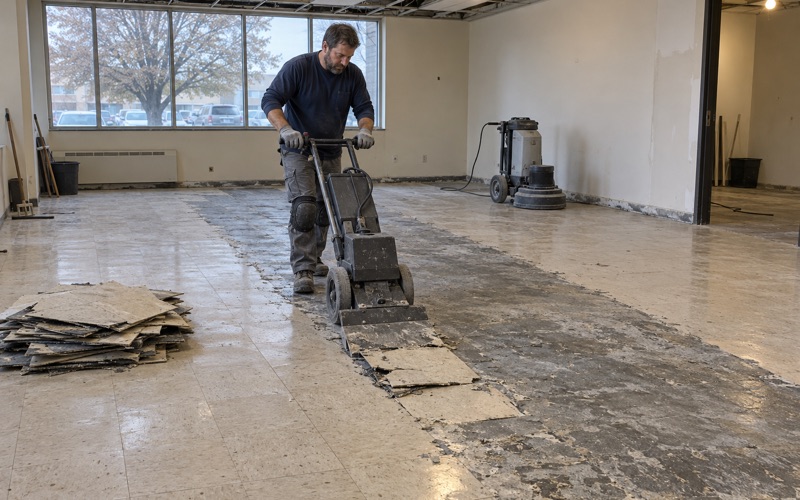
Each zone gets the same survey before a price is final. Cracks, spalls and any old coating are mapped, and we say so when a section needs repair or replacement before it should be coated. In a phased job that survey also tells the owner which zones carry extra repair time, which keeps the schedule honest.
Profile comes from the grinder or shot blaster, matched to the ICRI concrete surface profile the chosen system calls for. Acid etching is not part of our method anywhere. In an occupied building the vacuum-equipped grinder is also the cleaner option, which matters when the room next door is still in use.
Moisture testing and what the warranty leaves out
Moisture is tested on every slab, whatever year it was poured. Depending on the job that can mean ASTM F2170 in-situ relative humidity probes, ASTM F1869 calcium chloride testing or an ASTM D4263 plastic sheet check as a first read. Where the readings call for it, a moisture-mitigation primer goes into the scope before the base coat.
We also explain what a coating warranty leaves out before the job is sold. Moisture vapor transmission and hydrostatic pressure are the first exclusions we name, because no topcoat can fix a slab pushing water up from below. Saying so at the proposal stage costs nothing, while finding it out after the floor lifts costs a great deal.
Homes and garages in Marion too
Healthcare spaces are only part of the work here. Marion has 10,886 owner-occupied detached houses, and 7,469 housing units, or 41.4 percent, were built in 2000 or later. A newer house is not automatically a drier garage, so those slabs get the same moisture test as an older one.
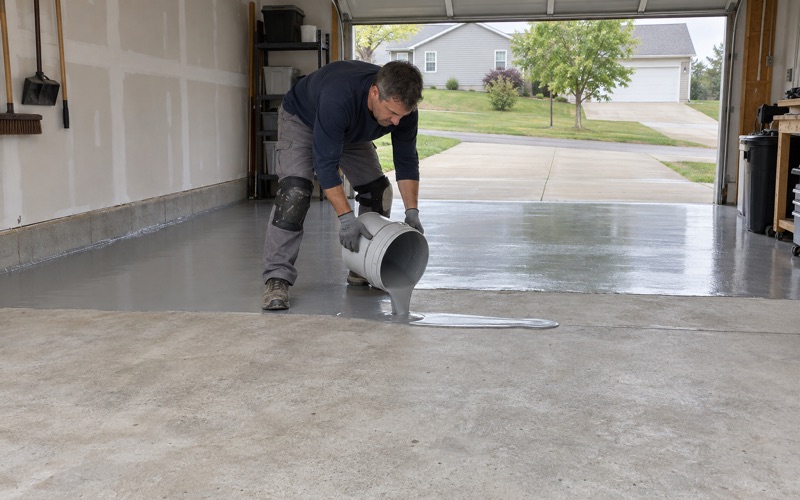
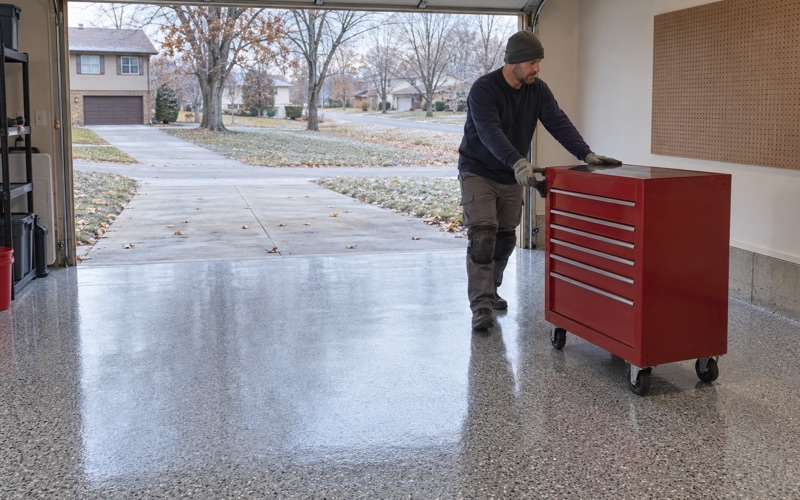
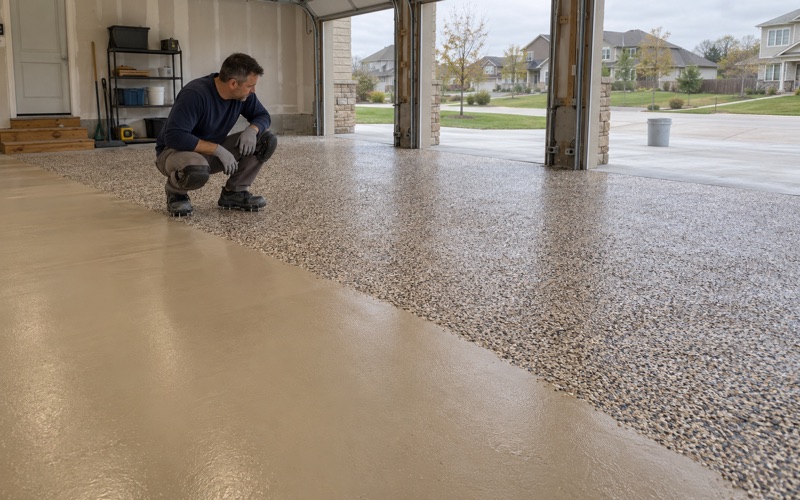
Garage systems are chosen to stand up to the brine and rock salt carried in on tires from November through March, and an unheated garage in winter is told to wait for conditions that let the coating cure properly. Slip resistance comes from the broadcast and topcoat we specify, written into the proposal rather than promised as a slogan.
- 20+ Years Coating Concrete
- Moisture Test in Every Scope
- Free Written Estimates