
Iowa City Epoxy Flooring provides concrete grinding in Iowa City, IA, serving surrounding cities including Coralville, Tiffin, North Liberty, Mount Vernon and Amana. Grinding is the part of a floor job most customers never see once the work is done, yet in our more than twenty years on concrete it has proven to be the single biggest factor in whether a coating lasts or peels. We grind slabs ahead of our own coatings, and we also grind floors for owners and other trades who simply need the concrete opened, flattened or stripped clean.
The goal of grinding is a clean, sound surface with a known texture. Old paint, sealers, adhesives, oil and the weak top layer of paste all come off, and what is left is concrete a coating can actually bond to rather than a surface it merely sits on. We capture the dust at the machine with a vacuum on every job, so the work stays out of the rest of the building and away from drains.
What Concrete Grinding Removes
Old Coatings, Paint and Sealers
Many garages and basements around Iowa City carry a roll-on paint, a store-bought epoxy kit or a clear sealer that has started to peel. Those layers have to come off completely before anything new goes down, because a fresh coating bonded to a failing one simply fails along with it. We use metal-bond diamond tooling matched to the material, switching to more aggressive segments where a coating is thick or gummy.
Sealers are the trickiest to spot, since a sealed slab can look like bare concrete. A quick water drop test tells us whether water soaks in or beads up, and a slab that beads needs to be ground until it absorbs evenly again. Skipping that check is one of the quieter ways a coating ends up peeling in its first year.
Adhesive, Mastic and Glue Residue
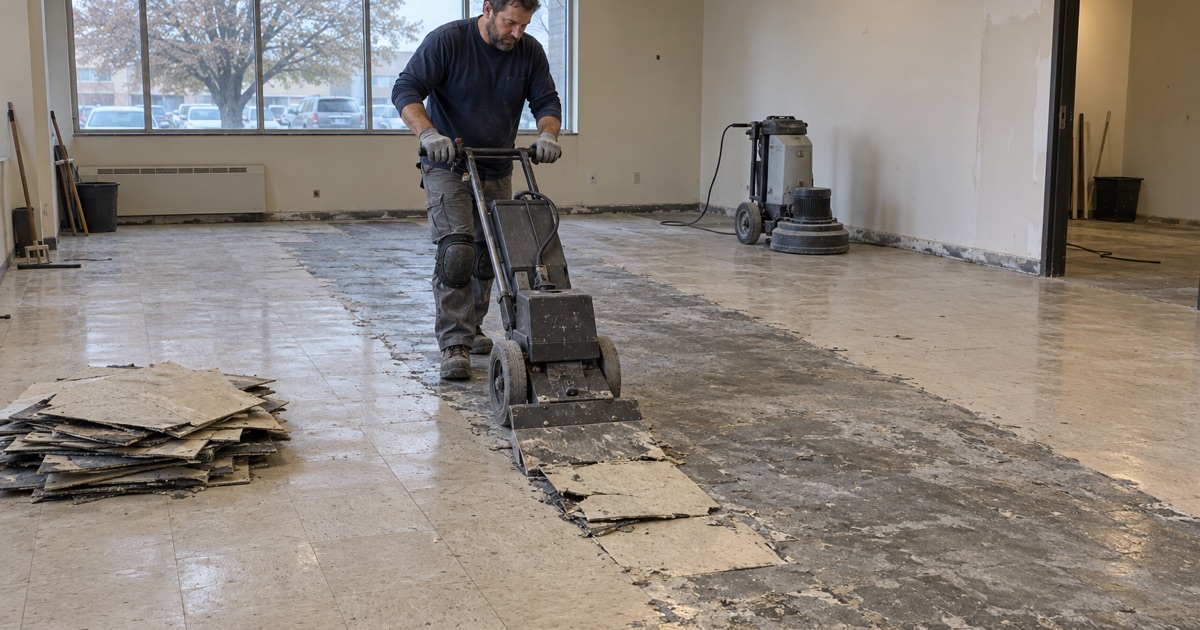
Basements and commercial spaces often hide carpet glue, tile mastic or vinyl adhesive under the flooring that was pulled up. These materials gum up ordinary tooling, so we use segments designed for adhesive removal and sometimes scrape off the bulk first. The aim is concrete that looks and feels clean across the whole floor, with no shiny patches of residue left behind.
Old black mastic and some older floor tiles can contain asbestos. When we see materials that may need testing, we stop and tell you before grinding starts, because grinding is exactly the wrong way to find out. Testing is inexpensive compared with the cleanup that follows a mistake.
Laitance, Contamination and Weak Surface Paste
New and old slabs alike can have a weak, powdery top layer called laitance, left behind when water rises to the surface during finishing. Coatings that bond to laitance can lift off with it, taking the paste along and leaving the floor looking peeled. Grinding takes the surface down to the stronger concrete underneath.
Oil and fluid stains in garages and shops are another kind of contamination. We grind out what we can and treat deep stains before coating, since oil that remains in the concrete can push back up and break the bond over time.
Diamond Grinding and Shot Blasting
Diamond Grinding for Most Floors
A planetary diamond grinder uses rotating heads fitted with diamond segments to cut the surface evenly. It removes coatings, flattens high spots and leaves a consistent scratch pattern, and it can be finished along walls and in corners with hand grinders. For most garages, basements and interior commercial floors, it is our first choice.
Grinding also lets us control how deep we cut. That matters on polished floors, where depth decides how much aggregate shows, and on coating jobs, where we want a profile and not a wavy floor.
Shot Blasting for Large and Heavy-Duty Slabs
A shot blaster throws small steel shot at the slab and vacuums it back up along with the debris. It produces an aggressive, uniform profile quickly and suits large warehouse floors, thick coating systems and overlays. Because the shot is recycled through the machine, the process stays relatively clean.
Shot blasting leaves a rougher surface than grinding, which is ideal for thick industrial systems but too coarse for thin coatings. We choose the method by the coating going on top, not by what is fastest for us.
Surface Profile and Why It Matters
ICRI Concrete Surface Profiles
The International Concrete Repair Institute publishes a set of reference chips, CSP 1 through 10, that describe surface texture from nearly smooth to very rough. Coating manufacturers specify which profile their products need, and we match the grinding to that requirement. A thin sealer might call for a light profile; a thick urethane cement needs a much deeper one.
Meeting the right profile is what gives a coating its mechanical bond. Too smooth and it has nothing to grip; too rough and a thin coating cannot cover the peaks, leaving a weak spot at every ridge.
Flattening High Spots and Trip Edges
Grinding can also remove lips at slab joints, high spots from uneven pours and ridges left by old repairs. That makes floors safer to walk on and easier to roll equipment across. For businesses, taking down a trip edge can be a simple fix that keeps a floor in service without replacing the slab.
Dust Control and Clean Job Sites
Vacuum Capture at the Machine
Concrete dust contains crystalline silica, so we capture it at the source. Every grinder and shot blaster we run connects to an industrial vacuum with filtration sized for fine dust, and hand tools at the edges are shrouded the same way.
Keeping Residue Out of Drains
We sweep and vacuum grinding residue rather than rinsing it away. Washing slurry toward a floor drain or a storm inlet sends concrete fines into pipes and waterways, so we collect it and dispose of it with the job waste.
- 20+ Years Coating Concrete
- Moisture Test in Every Scope
- Free Written Estimates