
Iowa City Epoxy Flooring handles concrete floor repair in Iowa City, IA, serving surrounding cities including Coralville, Tiffin, North Liberty, Mount Vernon and Amana. Cracks, spalls, pitting and salt scaling are part of life for concrete in eastern Iowa, where freezing nights, road salt and damp soil all work on a slab year after year. We repair those defects as their own job or as the first stage of a new coating, and after more than twenty years on these floors we know which damage is cosmetic and which is a sign of something deeper.
Every repair starts with mapping. Before we quote, we walk the slab and mark cracks, spalls, scaled areas, failing joints and old coatings, and we note whether each one looks stable or active. That map becomes part of the written proposal, so you know exactly what is being repaired and why, and it is the basis for an honest answer when a slab needs replacement rather than another patch.
Common Concrete Floor Damage Around Iowa City
Salt Scaling and Freeze-Thaw Damage
Scaling is the flaking or pitting of the top layer of concrete, usually in garage wheel tracks and near overhead doors. It happens when calcium chloride and rock salt brine soak into the surface and then freeze and thaw, cycle after cycle, until the paste breaks away and the aggregate shows. Iowa winters provide plenty of those cycles between November and March, and a bare garage floor shows it within a few seasons.
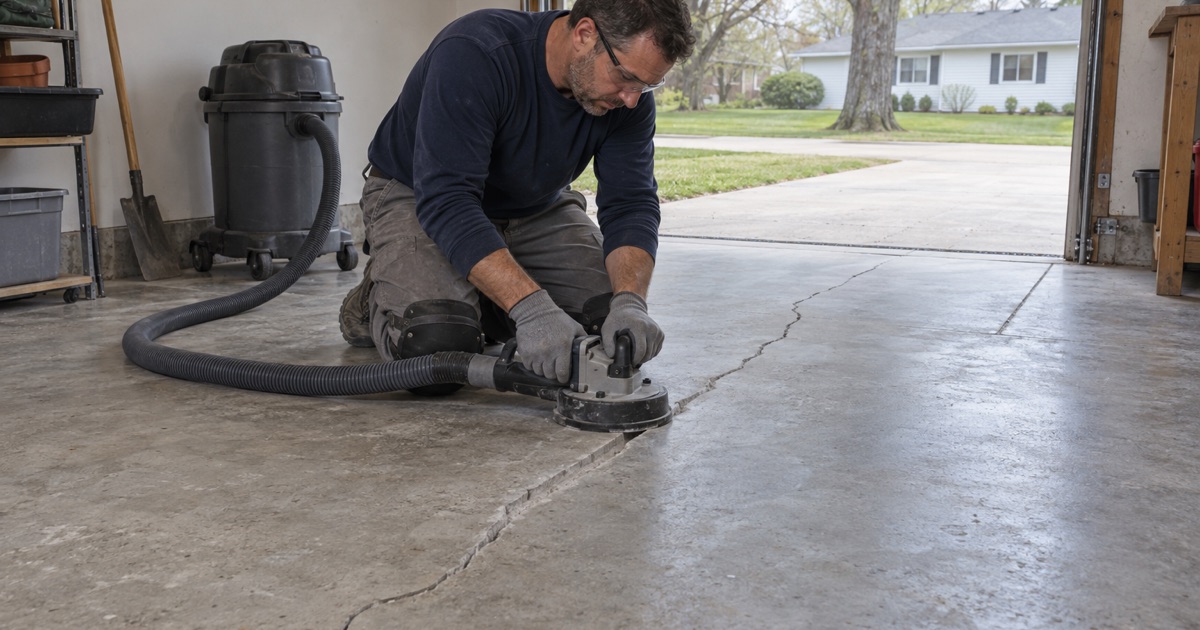
We grind the scaled area back to sound concrete and rebuild it with a polymer-modified repair mortar or an epoxy mortar. A coating or sealer over the repair then keeps the next winter’s brine from soaking in and starting the process again. Without that protection, a repaired area will eventually scale the same way the original surface did.
Cracks From Shrinkage and Settlement
Nearly every slab cracks a little as it cures and shrinks, and most of those hairline cracks are harmless. Wider cracks can come from settlement, frost movement or heavy loads, and some continue to open and close with the seasons. We judge each crack by its width, its edges and whether the two sides sit level with each other.
Stable cracks are cleaned out and filled with a rigid epoxy or polyurea filler, then ground flush. Moving cracks are better treated with a flexible filler, and we tell you plainly that they may show through a coating later. That conversation is more useful before the floor is finished than after.
Spalls, Pop-Outs and Broken Edges
Spalls are chips and broken areas, often along slab edges, around floor drains and at the door threshold where the garage meets the driveway. Pop-outs are small cone-shaped holes left when a piece of aggregate near the surface fractures. Both are common on older Johnson County slabs and on floors that have seen years of salt and heavy wheels.
We saw-cut or grind around larger spalls to create clean, square edges, then fill them with a repair material suited to the depth and the traffic. Small pop-outs are filled during the coating prep, so the finished floor reads as one even surface.
Joint and Edge Repair
Control Joints and Construction Joints
Joints let a slab move without cracking at random, but their edges are the weakest part of the floor. Forklift and pallet-jack wheels chip them, salt water collects in them, and old fillers dry out and pull away. We clean out failed joints, rebuild broken edges, and refill them with a material matched to how the floor is used.
In a warehouse, a semi-rigid filler supports the joint edges under hard wheels. In a garage or basement, we may fill joints for a seamless look or leave them open to let the slab move, depending on how active they are.
Door Thresholds and Garage Aprons
The edge where a garage floor meets the apron outside takes the worst of the weather and the traffic. It is often cracked, spalled or lower than the slab inside, which lets meltwater run under the door. We rebuild that edge and, where it helps, shape it so water drains out rather than in.
If the apron itself is broken or heaved, that is usually exterior flatwork beyond a floor repair. We tell you when that is the case so the right contractor can handle it.
When Repair Is Not Enough
Slabs That Should Be Replaced
Some floors cannot be fixed with patching. A slab broken into loose sections, one that has heaved badly from frost, or one that has sunk because the soil underneath washed out will keep failing no matter how carefully it is repaired. Coating over that kind of damage only hides it for a season or two.
We say so when a slab needs replacement. That answer can cost us a coating job, but it saves you from paying for a floor that will crack again along the same lines.
Moisture Problems Behind the Damage
Some damage, like efflorescence, scaling in basements or coatings lifting in patches, points to moisture rather than wear. In those cases we test the slab before any repair, and we look at drains, the sump pit and grading. Repairing the surface without addressing the moisture tends to bring the damage back.
A floor repair or coating is not waterproofing. Where water is the real problem, we will tell you what we see and suggest that it be addressed first.
Repair Materials and Finishes
Choosing the Right Repair Material
We choose repair materials by depth, traffic and the finish going on top. Epoxy and polyurea fillers suit cracks and small spalls; polymer-modified cementitious mortars suit larger, deeper areas; and self-leveling underlayments suit broad low spots. Each has its own cure time, which we build into the schedule.
Repair Before Coating
When a coating follows, all repairs are ground flush so they disappear under the finished floor. The proposal lists the repair work separately from the coating, so you can see what each part of the job costs.
- 20+ Years Coating Concrete
- Moisture Test in Every Scope
- Free Written Estimates