Iowa City Epoxy Flooring brings more than 20 years on concrete to epoxy flooring in Cedar Rapids, and the question we hear most from plant managers here is a practical one: will this floor be easier to keep clean? On production floors where dust settles every shift, a coating earns its place by how quickly a crew can sweep and vacuum it back to a bare, sealed surface.
We are a coating contractor, not a safety consultant. A floor system does not replace a plant’s cleaning program, does not stop a dust explosion and does not make a facility meet any federal standard. What it can do is remove the pores, open joints and broken edges where dust likes to hide, so the cleaning the plant already owes takes less time and leaves less behind.
Every proposal names the product line, the coat count and the finished thickness, so your maintenance lead can check the installed floor against the paper. Before we price anything, we map cracks, spalls and old coatings, and we tell you plainly when a section needs repair or replacement before a coating belongs on it.
Cedar Rapids Floors That Carry Grain, Oats and Soybeans
The Quaker Oats Plant on 2nd Street NE
Few cities mill grain on the scale Cedar Rapids does. The Quaker Oats plant at 418 2nd Street NE has been called the largest cereal mill in the world, and as of 2022 it employed 740 people. Its tallest section rises 13 floors and 190 feet, which gives a sense of how many floor surfaces a single grain operation can hold.
We have no relationship with Quaker, and we mention the plant only because it shows what floors in this city are asked to do. Oats, cereal and pancake mix all start as dry product moving through mills, conveyors and packaging lines. Wherever that product travels, fine particles escape and settle, and floors are the largest flat surface they land on.
Soybean Processing on C Avenue NE
Cargill runs an east soybean facility at 410 C Avenue NE near Cedar Lake, and the company has proposed a $37.62 million expansion and modernization there, adding 27,000 square feet within the existing footprint. Cargill also operates a corn milling plant in southeast Cedar Rapids and a west soybean processing facility. We have no tie to any of these operations.
Projects like that one matter to floor work across the city, because new construction inside an old footprint often meets an older slab at a seam. Where fresh concrete butts against a floor that has carried decades of traffic, the joint and both surfaces need attention before any coating goes down, or the line between them becomes the first place dust and spilled product collect.
Which Areas a Plant Treats Under the Grain Standard
The federal grain handling standard, 29 CFR 1910.272, lists grain elevators, feed mills, flour mills, dry corn mills, soybean flaking operations and the dry grinding of soycake among the facilities it covers. Corn wet milling is not on that list. Which rooms of a given plant fall under the standard is the employer’s determination, never ours.
We ask for that determination at the start of a job, because it shapes how we schedule, how we capture our own dust and which areas need the smoothest finish. A shop office at the same address may follow different rules than the floor beside a bucket elevator. We plan the coating around the plant’s own answers rather than guessing at them.
Looking for epoxy-flooring closer to Washington? See Epoxy-Flooring in Washington.
What the Housekeeping Program Asks of a Floor
Fugitive Grain Dust Under the Iowa Rules
Iowa runs a state plan, so Iowa OSHA enforces workplace safety here. Under 481 IAC 210.4, the state adopts the federal general industry rules from 1910.20 onward as the rules implementing Iowa Code chapter 88, which brings the grain standard into Iowa plants. Those rules moved out of the old Labor Services Division chapter in July 2025.
Paragraph (j)(1) of the standard requires a written housekeeping program that sets how often and by what method the employer reduces fugitive grain dust on ledges, floors, equipment and other exposed surfaces. Fugitive grain dust means combustible particles that pass a U.S. Standard 40 mesh sieve, 425 microns or less. Particles that fine work their way into every open pore of a bare slab.
Priority Floors Near Bucket Elevators, Grinders and Dryers
At grain elevators, the program names priority areas. They include floors within 35 feet of inside bucket elevators, floors of enclosed areas that hold grinding equipment, and floors of enclosed areas that hold grain dryers inside the facility. In those zones, accumulations over 1/8 inch must be removed, or the employer must show equivalent protection.
Those are the floors we look at hardest during a site walk. A broken edge near an elevator boot or a worn traffic lane through a grinder room holds dust that a broom slides right over. When we map a slab before pricing, priority floors get their cracks, spalls and failed coatings marked first, so repair work there is never an afterthought.
Why Compressed Air Is Not the Daily Tool
Paragraph (j)(3) allows compressed air to blow dust off surfaces only when all machinery that presents an ignition source is shut down. In practice that pushes routine cleaning toward sweeping and vacuuming. Grain and product spills are a separate matter under (j)(4), not counted as fugitive dust accumulations, though the program still has to address their removal.
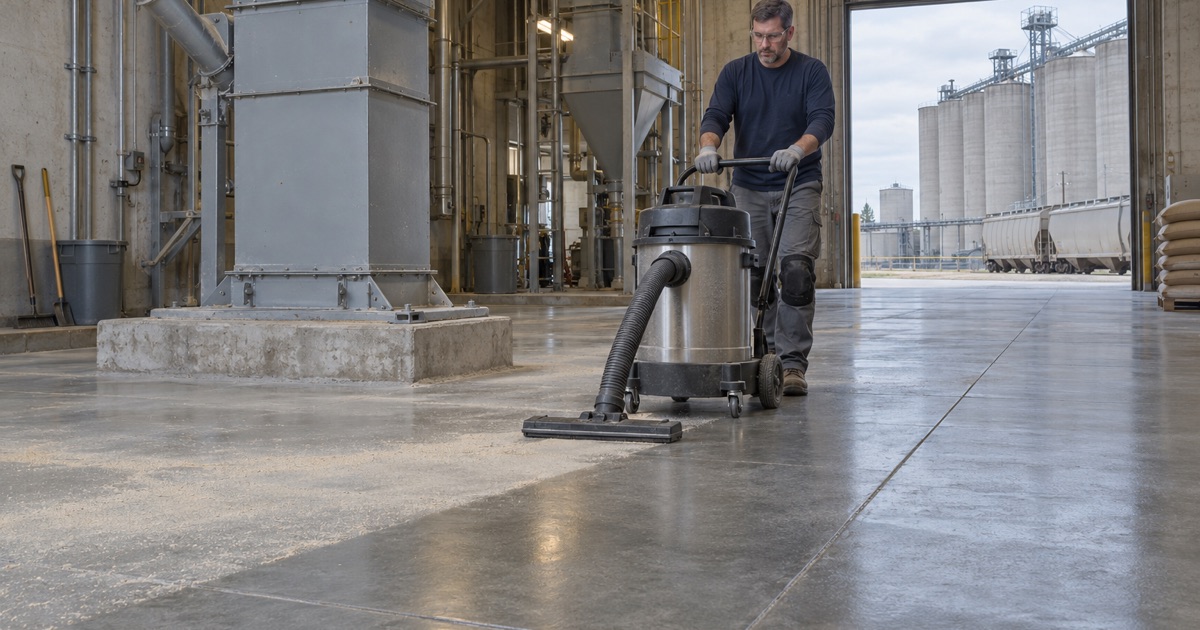
A floor that releases dust to a vacuum head on the first pass shortens every one of those cleanups. That is the honest case for coating a mill floor: less time per pass and less residue after it. The program, its schedule and the cleaning itself remain the employer’s responsibility, and no floor system changes that.
Why a Sealed, Joint-Filled Floor Sweeps and Vacuums Cleaner
Opening the Slab Without Acid
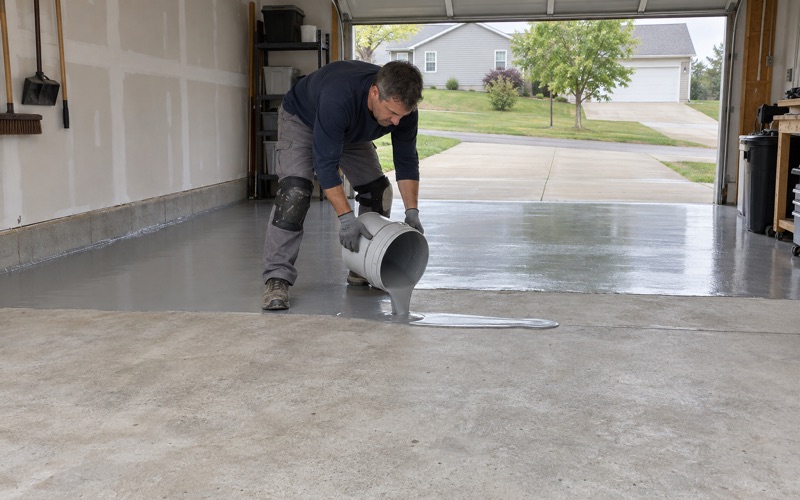
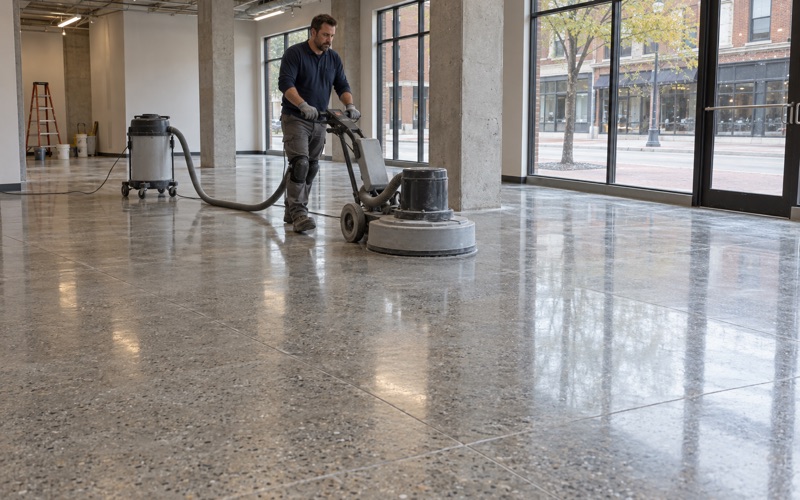
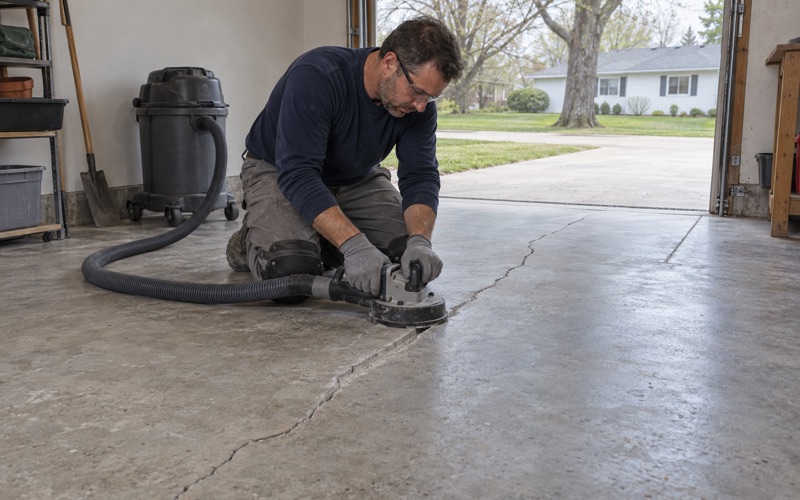
Bare concrete in a mill is porous, and years of traffic leave it rough in some lanes and polished in others. We open every slab with a diamond grinder or a shot blaster, never an acid etch, and aim for the concrete surface profile on the ICRI CSP scale that the chosen system calls for. That profile is what the primer actually grips.
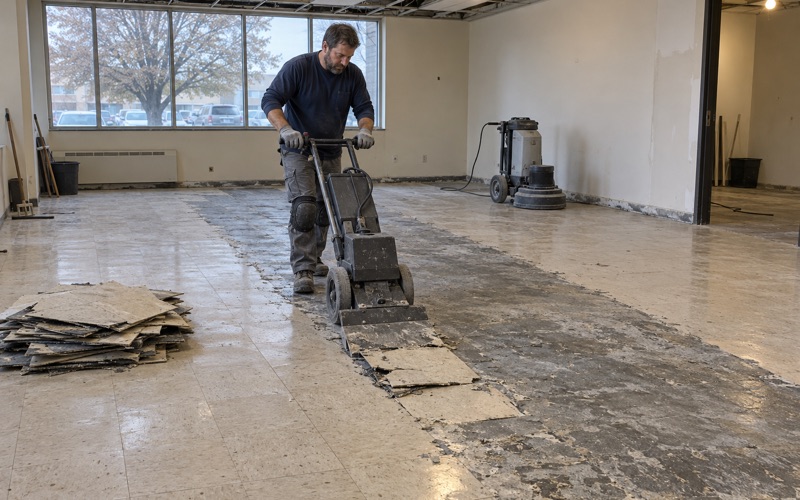
Grinding also removes old sealers, paint and contaminated surface that would otherwise let a new coating peel. Peeling edges are their own dust trap, so a coating that lets go in two years leaves a floor harder to clean than the bare slab it replaced. Preparation is where most of a floor’s working life is decided.
Joints, Cracks and Spalls Filled Before the Coating
Saw-cut joints, random cracks and spalled edges are where dust lodges first on a slab that otherwise sweeps clean. We fill them with a semi-rigid or epoxy filler suited to the movement each joint sees, and we rebuild spalled edges before the body coats go down. Where a section is too far gone, we say so and recommend replacing it.
The result is a continuous surface without the open seams a broom skips over. Moving joints still need room to move, so we do not pretend a filler makes them disappear forever. We tell you which joints will want periodic attention and put that in writing with the rest of the scope, so your maintenance planner can track it.
A Texture That Still Sweeps
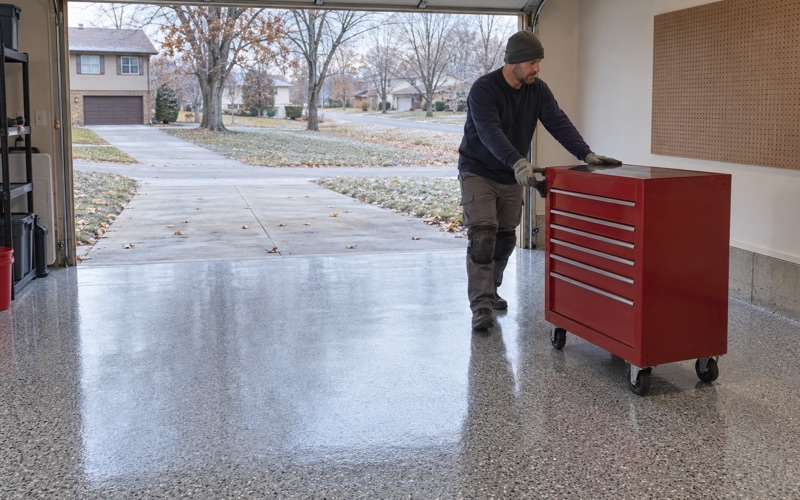
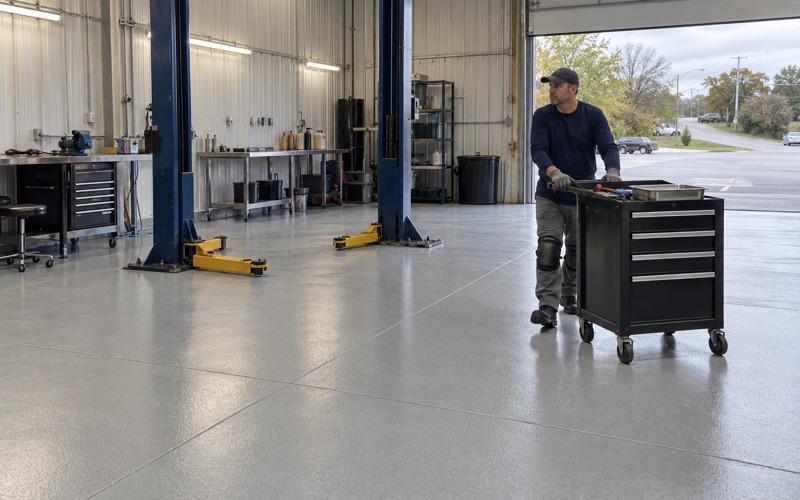
Slip resistance and cleanability pull in opposite directions, so we specify texture by the broadcast and topcoat used rather than promising it as a slogan. A light quartz aggregate broadcast locked under a 100% solids epoxy or urethane cement topcoat gives footing while staying shallow enough for a vacuum head. Heavier texture goes only where wet process areas demand it.
Urethane cement is often the choice near washdown areas or anywhere hot cleaning water reaches the floor, while a high-build epoxy suits dry storage and packaging rooms. We match each room to its use instead of running one system wall to wall, and each room gets its own line in the proposal so the differences are easy to see.
Scheduling Coating Work Around a Mill That Keeps Running
Phasing by Shift, Night and Weekend
Many plants in Cedar Rapids cannot stop a line for a week of floor work. We phase plant, warehouse and shop floors around shifts, using overnight and weekend windows and dividing large rooms into sections so production can route around the area being coated. The phasing plan is agreed before we start, not improvised on site.
Each section is closed, prepared, coated and cured before traffic returns. Coordinating with the plant’s own housekeeping schedule matters here, because a newly coated section should not be dusted over before it cures. We work with your safety and maintenance leads to keep cleaning crews and our crew out of each other’s way.
Capturing Grinding Dust at the Machine
Floor preparation makes dust of its own, which is the last thing a grain plant needs added to its housekeeping load. Our grinders and shot blasters run with vacuum collection at the machine, and the concrete dust is bagged rather than rinsed toward a floor drain. Where the plant restricts tools or work in certain rooms, we follow its rules.
We also ask about hot work permits and any area restrictions before mobilizing, since those decisions belong to the facility. Those answers set the equipment list, the crew size and the order in which rooms are prepared. Our crew works inside the plant’s own procedures rather than asking the plant to bend around ours.
Moisture Testing and Cure Before Return to Service
A moisture test is part of the written scope before the price is final, using ASTM F1869 calcium chloride kits or ASTM F2170 in-situ relative humidity probes as the slab calls for. Moisture is also the first exclusion we name when we explain what a coating warranty does not cover, so the limits are clear before the job is sold.
Cure follows slab temperature and the dew point spread at the surface, not the calendar. That matters in a section that has to reopen on Monday, because a coating rushed into service can show amine blush or soft spots that trap the very dust it was meant to shed. When a section needs another night, we say so.
- 20+ Years Coating Concrete
- Moisture Test in Every Scope
- Free Written Estimates