
Iowa City Epoxy Flooring coats basement floors with epoxy in Iowa City, IA, serving surrounding cities including Coralville, Tiffin, North Liberty, Mount Vernon and Amana. Basement floor epoxy is a different job from a garage floor, because the concrete sits against damp soil all year and the first question is always where the water goes, not which color to choose.
We have spent more than twenty years reading basement slabs in eastern Iowa. That experience shapes the order of our work: a look at the sump pit and floor drains for signs of past water, a moisture test before the price is final, and grinding down to sound concrete before any coating is mixed.
Done that way, a coated basement floor is easy to clean, brighter than bare concrete and tough enough for a laundry room, a home gym or a workshop. Done without those steps, it is one of the most common coating failures there is.
Reading the Basement Before We Coat It
Signs of Past Water
We look for water lines on walls, rust stains at the base of shelving, efflorescence on the slab and tide marks around the floor drain. Those signs tell us whether water has crossed the floor before, and a coating does nothing to stop it from crossing again.
If the basement has taken water, we talk through what happened and whether it has been fixed. A coated floor cleans up far better after a wet event, but it is not a barrier and we never present it as one.
The Sump Pit, Drain Tile and Floor Drains
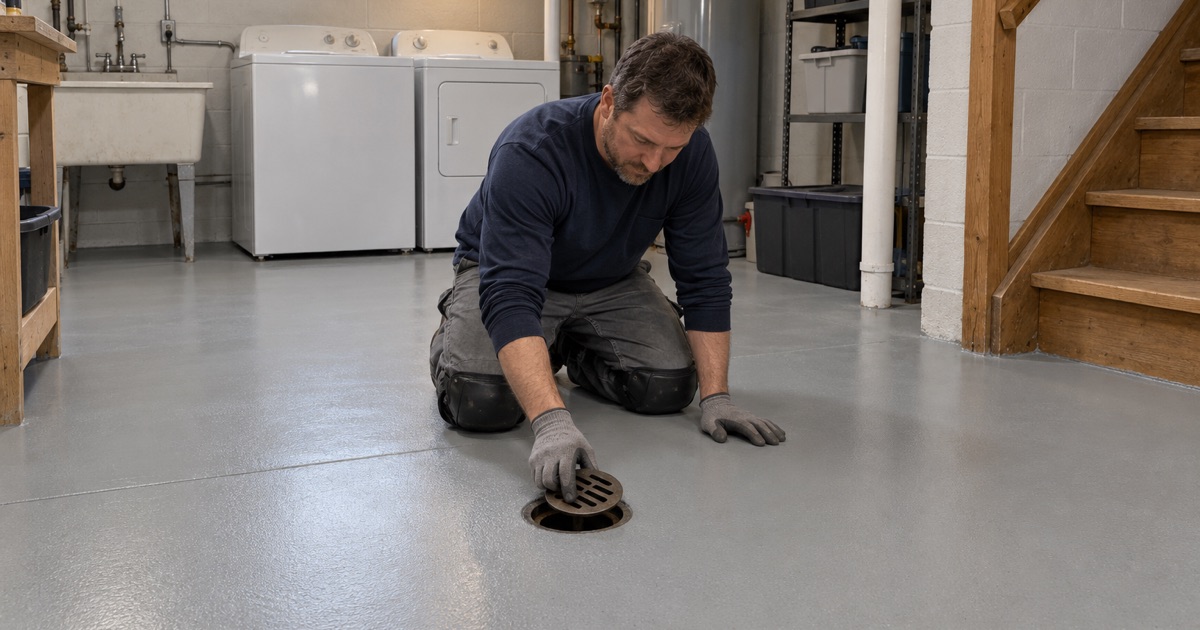
The sump pit shows how much water the drain tile is carrying, and the floor drains show where water goes when it gets in. We check that both are working and accessible, and we finish the coating neatly at the drain edges and around the sump lid.
We never coat over a floor drain or seal a sump that the house relies on. Those openings are part of how the basement stays dry, and closing them off with a floor coating trades a clean look for a wet basement.
Efflorescence and Hydrostatic Pressure
White, powdery deposits on the slab are efflorescence: mineral salts left behind as moisture moves up through the concrete and evaporates. Where groundwater pushes on the slab from below, the force is called hydrostatic pressure, and it can lift a coating that has nothing to do with its own quality.
Both are reasons to test before coating. They are also the conditions most coating warranties exclude, which is why we explain those exclusions before the job is sold.
Moisture Testing and Primer Choices
How We Test a Basement Slab
Our first read is often a taped plastic sheet under ASTM D4263, which shows whether moisture condenses beneath it. Where we need a number, we use calcium chloride emission tests under ASTM F1869 or in-situ relative humidity probes under ASTM F2170.
The results go into the written scope. That way the decision about primer, system and warranty is made on paper before the price is final, not halfway through the installation.
When a Moisture-Mitigation Primer Is Needed
If the slab tests above the limit for a standard epoxy, we add a moisture-mitigation primer to the system. It is designed to hold back a measured level of vapor emission so the coats above it stay bonded.
The primer adds cost and some time, and it is not a cure for flowing water. It is a tool for damp slabs that are otherwise sound, and we tell you plainly when a slab is beyond it.
When We Recommend Not Coating
Some basements are not good candidates for a coating at all. A slab with an active leak, frequent standing water or readings far beyond what any primer can handle is better served by fixing the water problem first, or by polishing the concrete instead.
We would rather lose a job than install a floor we expect to fail. Saying so is part of the service.
Preparing Older Basement Floors
Old Paint, Tile and Mastic
Many basements under older Iowa City houses and duplexes carry layers of paint, floor tile and black mastic from earlier remodels. We remove them by grinding or shot blasting down to clean, sound concrete, and we capture the dust at the machine with a vacuum.
Some old floor tiles and adhesives can contain asbestos. If we see materials that may need testing before removal, we stop and tell you, rather than grinding first and asking later.
Cracks, Patches and Uneven Areas
Basement slabs often have settlement cracks, patched trenches from old plumbing work and low spots near the drain. We fill and grind repairs flush, and we point out any crack that looks active so you know what the coating can and cannot hide.
A very uneven floor may need a self-leveling underlayment or a resurfacer before coating. That is a separate line in the proposal, and we explain when it is worth doing.
Systems and Finishes for Basement Rooms
Laundry Rooms and Utility Areas
Around washers, water heaters and utility sinks, a sealed floor makes leaks and spills easy to spot and clean. We often add a light texture in these areas so a wet floor is less slippery.
We also leave room at the floor drain for water to reach it. A coating that is built up into a lip around the drain grate holds a puddle on the floor, so the edge is feathered down to let a leak run where it should.
Home Gyms and Workshops
Weights, machines and tools are hard on a floor. A thicker build, a quartz or flake broadcast and a tough topcoat help the floor stand up to dropped plates, rolling tool chests and sawdust.
Under a squat rack or a heavy bench, rubber gym tiles over the coating spread the load and protect both the floor and the equipment. In a woodshop, a satin finish hides fine dust better than a high gloss and makes the floor easier to sweep between projects.
Family Rooms and Finished Spaces
In living areas, a metallic epoxy or a fine flake blend gives a finished look that pairs well with area rugs. Low-odor products help when the rest of the house is occupied during the work.
A basement floor stays cooler than the rooms above it, so many owners add rugs where people sit. We recommend breathable rug backings and leave written care notes so the finish keeps its look for years.
Rentals, Radon and Iowa City Rules
Rental Basements and Turnovers
Iowa City runs a rental permit and inspection program under its Housing Code, and many rental basements are inspected on a regular cycle. A coated basement floor is easier to clean between tenants, and we schedule work into the gap between leases.
For landlords with several units, we can plan floors on a turnover calendar so each basement is done when it is empty. The same moisture test and drain check apply to every unit, because rental basements in older houses vary widely from one address to the next.
Radon Is Separate Work
Every Iowa county is in EPA radon Zone 1, and Iowa City requires radon testing and, where levels are high, mitigation in single-family and duplex rentals. That work is done by state-credentialed radon professionals under Iowa Code chapter 136B, and a floor coating is never a substitute for it.
If a radon system is planned, we coordinate around it. The mitigation contractor’s sealing of the sump and slab openings, and the placement of the suction point, come first, and our floor is finished around that work rather than over it.
- 20+ Years Coating Concrete
- Moisture Test in Every Scope
- Free Written Estimates